Thanks for visiting this blog, created in July 2012 out of great concern for the fate of the €uro currency area, once again on the verge of collapse due to the economically ill-advised and heartless austerity policies imposed on Greece, Spain and other heavily-indebted €uro area countries by a christian democratic German chancellor impressed with the budgeting skills of Schwabian housewives. Meant to reduce the public debt and put the countries back on a path to economic growth, these macro-economically idiotic policies are doing anything but cause "pointless misery" as Paul Krugman so aptly describes it (Bloomberg, July 23-29, 2012).

Instead of reducing public debt, the austerity measures set in motion a vicious cycle of economic contraction, rising unemployment and poverty, lower tax revenues, private capital flight, and rising public debt shares as the economy declines faster than the public debt. What’s more, the austerity-driven ‘blood, sweat and tears’ policies recommended to the European periphery derive from the same economic doctrine that brought us to the brink of disaster in 2008. These policies are not only misanthropic and counterproductive to economic growth and debt reduction in Europe, but will prove explosive for the €uro currency area unless a drastic change of course takes place - and soon.

While I do not pretend to have ‘the’ solution for the €uro crisis, I would like to offer alternative economic perspectives and views on current events, and hope to chart a more humane path toward a balanced, socially fair, and sustainable economic future for the €uro area.

On the origins of the 2008 Great Financial Crisis:
“
90+% of traders are men, and they bet all of our bank deposits on liar loans which froze credit leading to 40% average losses passed on to ordinary taxpayers; then begged for trillion-dollar bailouts upon which they paid themselves 50% higher boni.”


Sunday, November 18, 2012

The fiscal multiplier and austerity in the eurozone


As I had mentioned in my post "What do recent events mean for the EU and economic policy in the eurozone?", part II and III, the IMF's World Economic Outlook of October 2012 presented new evidence of a larger than assumed fiscal multiplier, now found to be in the order of between 0.9 and 1.7, instead of 0.5 as previously estimated (see WEO 2012. chapter 1, box 1.1).

Before thís momentous concession that IMF economists had underestimated the fiscal multiplier, there were three different 'camps' regarding the impact of austerity on economic growth:

1.) The 'expansionary austerity' camp [fiscal multiplier = 0]
Proponents of the expansionary austerity view argue that fiscal contraction would not only NOT reduce economic growth, but might even enhance growth through exchange rate and confidence effects. The supply-side research papers of Alberto Alesina have been particularly influential in certain economic policy circles and were quickly picked up by European policymakers as a justification for the austerity programs imposed on Greece and other Southern European countries in return for EU financial assistance. While German finance minister Schäuble is a staunch supporter of the expansionary austerity school, Larry Summers thinks "that the idea of expansionary austerity is oxymoronic"...."you can drop the prefix." (see my post "Austerity chickens are coming home to roost in Germany").

2.) The mainstream camp [fiscal multiplier = 0.5]
This camp, which included the IMF and the Bank of England, held that the impact of austerity on economic growth would be significant, but only moderately so. Examining data from the last three decades, the IMF concluded in October 2010 that "fiscal consolidation typically lowers growth in the short term."...."we find that after two years, a budget deficit cut of 1 percent of GDP tends to lower output by about 1/2 percent and raise the unemployment rate by 1/3 percentage point." (see press points for chapter 3, World Economic Outlook 2010)

3.) The 'recessionary austerity' camp [fiscal multiplier > 1]
Economists in the third camp, including Paul Krugman, Brad Delong, Martin Wulf (Financial Times) and Simon Wren Lewis, argue that the experience of the last three decades is not relevant to today's liquidity trap environment. In a liquidity trap environment, central banks' injections of cash into the banking system fail to stimulate economic growth because banks and people hoard cash. As people expect insufficient aggregate demand and/or deflation, they prefer to hoard their money instead of investing or consuming it, so that the impact of monetary policy is either zero or very moderate due to its limitation by the zero lower bound of interest rates. In such a situation, only fiscal policy will have an impact on economic growth, with the fiscal multiplier most likely larger than 1. For the eurozone, this means that each €uro of fiscal austerity will reduce economic activities by >1 €uro, specifically by between €0.9 and €1.7.

-------------------------------------------------------------------------------------------------------------------------------------------
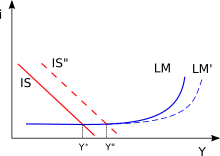


The chart above shows the liquidity trap as visualized in a IS-LM diagram. A monetary expansion (the shift from LM to LM') has no effect on equilibrium interest rates or output. However, fiscal expansion (the shift from IS to IS") leads to a higher level of output with no change in interest rates.
-----------------------------------------------------------------------------------------------------------------------------------------

Since October 2012 I believe it is fair to say that at least the IMF's Chief economist and his team of economists have moved from the mainstream camp to the recessionary austerity camp. Here is the key paragraph of their research findings on fiscal multipliers: "Our results indicate that multipliers have actually been in the 0.9 to 1.7 range since the Great Recession. This finding is consistent with research suggesting that in today's environment of substantial economic slack, monetary policy constrained by the zero lower bound and synchronized fiscal adjustment across numerous economies, multipliers may be well above 1."  (see WEO of October 2012)


What does all this mean for the eurozone ?

In view of economic developments in the eurozone since the Great Financial Crisis in 2008, one doesn't have to be an economist to conclude that ECB monetary policy has been ineffective in terms of its impact on economic growth: while interest rates reached historically low levels, economic activity has slumped in the periphery and slowed down in the core, with banks withholding credit and corporations postponing investments; with consumers foregoing consumption, prefering to put their money under the mattress or depositing it in other countries perceived as safe havens (predominently Germany, Luxemburg, or Switzerland).

Anybody with common sense can also observe that fiscal policy has had a severe impact on the economies of the eurozone's Southern periphery: In Greece, the fiscal contraction imposed by the troika to lower the country's debt in relation to its GDP caused a dramatic slump in GDP, from €249 bln in 2009 to €194 bln in 2012. Instead of lowering the debt ratio, the economic contraction increased the burden of Greek debt in relation to its dramatically lower GDP from 120% in 2009 to 176.7% of Greek GDP in 2012 (Eurostat data). This suggests that the fiscal multiplier has indeed been much larger than 0.5 as initially estimated by the IMF in 2010. Applying the IMF's revised multiplier estimate of 1.7, the new fiscal cuts of €13.5 bln just approved by the Greek parliament would lower Greek GDP by €23 bln to €171 bln, increasing the debt ratio to 203% of GDP ! At that point, Greece would need another €100 bln from the European taxpayer just to keep it going.

Similar fiscal multiplier effects can be observed in Spain and Portugal. Instead of putting the Southern periphery on a path toward sustainable growth, the austerity polices imposed by the troika have dramatically lowered the countries' GDP, thus increasing public debt ratios and creating a humanitarian crisis so dramatic that it provokes regular massive demonstrations against the inhumane spending cuts focused on the weakest members of society: the old, the young, and the poor. 

The conclusion is obvious to anybody but the Very Serious People in power: A continuation of the austerity policies in the eurozone worsen the debt burden and the humanitarian crisis in the countries of the eurozone's periphery, reinforce the trend toward violent opposition and foster the growth of militant, nationalist movements. These trends already threaten "Europe's cohesion and the ideals behind the European Union" (George Soros) and seriously endanger the 60-year peace period in Europe, mocking the recently awarded Nobel Peace prize.

Hence, it is urgent and indispensable to immediately STOP the austerity measures, take up Mr. Soros' offer to "commit serious financial resources", and design a more appropriate, sustainable, and humane economic adjustment strategy for the entire eurozone. 

Sunday, November 11, 2012

Best-case economic scenario postponed

In my post "What do recent events mean for economic policy in the eurozone ? Part III" I defined the best-case scenario as a "new approach in economic policy", away from the current deflationary austerity toward a more humane, job-creating growth strategy, "with a completely different political coalition in Germany" and argued that the feasibility of such a scenario depended on the outcome of the primary of Germany's Green party.

Well, the Green party's primary results are in and suggest, unfortunately, that a U-turn in economic policy making in the eurozone is highly unlikely. Let me explain why:

Germany's Green party members have elected Jürgen Trittin and Katrin Göring-Eckhardt as their leaders for the 2013 parliamentary elections, two veteran politicians who during the last red-green government from 1998-2005 supported the economic policies of Agenda 2010: an employer-friendly, supply-side economic program of labor market reforms prepared by the global media conglomerate Bertelsmann Group and broadly supported by Germany's corporate interest groups (see my post: "Blueprint of labor reforms in Greece: Germany's Agenda 2010").

Katrin Göring-Eckhardt, a trained evangelical theologian without academic degree, career politician and Agenda 2010 supporter apparently does not see a conflict between the humanitarian values of the evangelical gospel and her support for the inhumane policies of Agenda 2010 which have thrown millions of German citizens into poverty and forced them into accepting menial jobs paying €1 an hour. Everybody can be excused for making mistakes, but the fact that she has not distanced herself from the inhumane Agenda 2010 policies, in my eyes, makes her untrustworthy and unelectable.

Trittin (a trained sociologist, career politician, and one of this year's invitees at the Bilderberg conference) is making some politically correct noises designed to attract progressive voters. Nevertheless, when push comes to shove, he would not shrink from making compromises with Germany's powerful corporate and financial 'elite' to gain and remain in power. While compromises are per se not objectionable, they are at a minimum questionable, if not criminal, with a German 'elite' that insists upon imposing its Schwabian housewife policies of deflationary austerity in the eurozone's Southern periphery, against all evidence that such policies throw the economies into a depression, worsen the debt ratios, and create a humanitarian crisis so severe that criminal charges have been filed against Ms. Merkel and the leaders of the troika for crimes against humanity.

Given that the only feasible alternative to a Merkel government in Germany is a red-green coalition led by a social (!) democratic chancellor candidate Steinbrueck who is currently engulfed in a controversy about his €1.5 million earnings from speaking engagements while many of his fellow party members barely make ends meet with yearly salaries of €25.000 (an amount that Steinbrueck received for just one speech), doesn't make me very optimistic for a positive change in economic policies in the eurozone.

Sadly,I guess the only viable alternative is to keep up the democratic pressure to force real change. As President Roosevelt said to the union leaders when they proposed plans to include in the New Deal: "I agree with you, I want to do it, now make me do it !" (FDR, 1932)

Friday, November 2, 2012

Germanic Economic Mythology - update Jan 2013

Since the 2012 release of Quentin Tarantino's Django Unchained the global movie audience is familiar with the story of Brunhilde and Siegfried (i.e. the German Nibelungen saga) as told by Dr. Schultz. It is my personal pleasure today to present to you the economic sequel of this saga:

The economic sequel features the current German approach to economic policy making based on what can best be described as Germanic Economic Mythology:

It serves four gods and goddesses, namely

1.) the Swabian housewife [most revered for her budgeting skills]
2.) financial markets [the evil twin of the Schwabian housewife]
3.) competitiveness [the mother of exports]
4.) free and flexible markets [esp. as applied to labor markets]

Assisting the gods and goddesses are the invisible fairies, namely
  • the confidence fairy which helps motivate financial markets to invest
    and
  • the invisible hand which guides market participants toward the equilibrium between supply and demand, even if it means poverty-level wages.

The gods and their fairies live in dark forests filled with dragons and zombies (zombie banks, the inflation zombie, cockroach zombies). While zombie banks are regularly fed with corporate welfare payments in the hope that they can be reanimated, Germans desperately fear that the inflation zombie comes back to life because it might turn into a fire-spewing dragon. That is why they prefer to beat it down even when it shows no signs of life at all.


Germans also fear another, even more horrible dragon with three ghastly heads: the public debt. Its largest head is the federal government's debt, including the obligations of the national pension fund. The other two heads include the regional debt and the debt of the communes.  

To slay the three-headed monster dragon public debt and prevent the inflation zombie from turning into a fire-spewing dragon, draconic sacrifices are made on the altar of the most powerful gods, the financial markets and competitiveness.The sacrifices preferred by the most powerful gods are wages and social welfare benefits such as unemployment benefits, health care benefits, public pensions and the like. If the three-headed monster dragon public debt is really large and endangers the lifestyle of the gods, the ultimate sacrifice may be required:  human dignity and human life.  

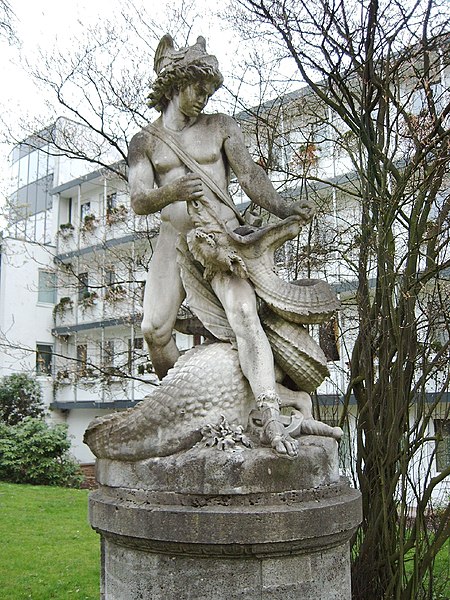
Statue of Siegfried slaying the dragon, Bremen.

Sunday, October 28, 2012

What do recent events mean for the EU and economic policy in the eurozone ? (part III)

Part I of this series provided an interpretation of the meaning of the Nobel Peace Prize award to the European Union, part II assessed the likelihood of a U-turn in economic policy in the eurozone under a new German government headed by the social democratic chancellor candidate Steinbrueck. 

Part III: German finance minister Schaeuble's recent pronouncements about Greece

Finance minister Schaeuble has always been steadfast (if not to say boneheaded) in his insistence that Greece would have to meet all the economic conditions and fiscal targets agreed upon in the March 2012 Memorandum of Understanding before the next tranche of financial assistance could be released. He said this in complete knowledge of the fact that without this next tranche of financing Greece would be bankrupt. Then, during a visit to Singapore in mid-October, to much of the world's surprise Schaeuble suddenly pronounced in broken english: "I think, there will no, it will not happen that there will be a Staatsbankrott in Greece." 

What explains Mr. Schaeuble's sudden change of heart, together with the apparent change in chancellor Merkel's stance toward Greece who suddenly decided to visit the country to declare her support for the country to remain in the eurozone ? Well, unfortunately, it was not the sudden enlightenment and realization that the inhumane austerity policies imposed on Greece are economically counterproductive (if not to say moronic) and extremely damaging to the social cohesion and peace in the country. Far from it ! Merkel's and Schaeuble's change of heart can be entirely traced back to intense pressure by China and the United States not to let Greece fall, or else ! 

It just so happens that Mr. Schaeuble's surprising pronouncement occurred a day after the close of the IMF/World Bank meeting in Tokyo from October 12-14 where IMF Managing Director Christine Lagarde urged that countries not sacrifice growth for the sake of austerity. Backed by new research of IMF Chief economist Olivier Blanchard and his team who found that the fiscal multiplier had been underestimated at 0.5 and is probably more in the order of 0.9-1.7 [*], Madame Lagarde said that "the pace of government debt reduction must be tempered by spending to help get the unemployed back to work." She further said that "without growth, the future of the global economy is in jeopardy." 

Madame Lagarde as well as high-level US and Chinese finance officials must have impressed on Mr. Schaeuble that a collapse of Greece triggered by a German refusal to release the next tranche of financing would seriously damage the world economy and would probably mean the end of the euro project. The latter point was underlined by a discrete diplomatic indication from Chinese officials that, in the event of a Greek bankrupty and exit from the eurozone, the Chinese government would sell €500 bln of their eurozone bond holdings. That, in fact, would mean the collapse of the euro project.

So, as in 2008/2009, it was international pressure rather than their own reassessment of economic policies that brought German politicians to reason. Thank you France, the US, China, and others for your intelligent intervention. I admire your capability to talk reason into German boneheads. Chapeau !

* * *

What does all this mean for economic policymaking in the eurozone ? Unfortunately, not much. We will probably remain stuck with Merkel, Schaeuble & Co, or Merkel & Steinbrueck, a combination that may improve economic policies only moderately, if at all. This is the base case scenario.

The Merkel/Steinbrueck combination may also worsen economic policies as Steinbrueck, a staunch Agenda politician and a model cost- and deficit-cutter, may introduce Agenda 2020 with more cuts in wages and pensions in Germany and elsewhere in the eurozone, thus reinforcing the deflationary austerity and leading the eurozone into a depression. This, obviously, is the worst-case scenario.


Whether a best-case scenario with a completely different political coalition in Germany and a new approach in economic policy is feasible depends on the outcome of the Urwahl (a sort of primary) of the German Greens at the beginning of November. More on this issue in one of my next posts.
______________________________
* This means that a 1%age point cut in public spending results in a 1.7%age point reduction in GDP.
   (See chapter 1 and esp. box 1.1 of the IMF World Economic Outlook of October 2012)


Sunday, October 21, 2012

What do recent events mean for the EU and economic policy in the eurozone ? (part II)


Part II: Mr. Steinbrueck's candidacy for German chancellor and economic policy in the eurozone

In my last post I argued that the alternative to a dissolution of the euro project is a 180° turn in economic policy for the eurozone by a new German government without Merkel. Today, I shall try to assess the likeliness of such an alternative with Mr. Steinbrueck (SPD) as the next German chancellor.

Merkel's October 18th Regierungserklärung (government policy statement) in the German Bundestag and the verbal blows that followed by chancellor candidate Steinbrueck provided the first indication of Steinbrueck's views and visions for the euro project as well as an idea of his economic policy approach toward Greece and the eurozone.


Steinbrueck started with a scathing critique of chancellor Merkel's mishandling of "the special German responsibility for Europe" and in particular of her failure to reprimand the "mobbing" of Greece and the brazenly chauvinist comments about the Greek people and other Southern Europeans by some of her coalition members, namely Mr. Rösler (economics minister), Mr. Söder (leading member of the Christian Social Union), Messrs. Dobrindt and Döring (leading members of Germany's liberal party FDP). Steinbrueck's stinging remark "You want to ride on the wave of public opinion that feeds on the ressentiments about Germany as the paymaster of Europe, but at the same time you want to avoid to dive into this wave...." further twisted the knife in the body of Merkel's damaged political standing, and his final statement served the knock-out blow: "Neither Mr. Kohl nor one of his predecessors would have allowed to use a European partner for political aims." 

Wow ! Hallelujah, Mr. Steinbrueck !

So far, so good. Yet, while Steinbrueck's attack of chancellor Merkel's coalition's treatment of Germany's eurozone partners was nothing less than brilliant, his recipes for economic policymaking in Europe were disappointingly unspectacular: banks shall fund future bail-outs out of their own bank-financed rescue fund; the need for a growth and employment pact and "a new social balance" in Europe; a desire to "export the successful mechanisms of the German social market economy" are all ideas that chancellor Merkel would approve of as well. 

Is this well-behaved economic policy approach an indication of Steinbrueck's secret wish to keep open the option of a second 'grand coalition' with Merkel, despite his rhetoric otherwise ? Most likely. As likely as the possibility that his economic views are really not very different from Merkel's. Let's not forget that it was Mr. Steinbrueck who supported (and still vehemently defends) the employer-friendly austerity measures of Agenda 2010 which now serve as the blueprint for labor market reforms in Greece (see my post on this issue). Let's neither forget that he supported the liberalization of Germany's financial markets during his time as finance minister of the first grand coalition with Merkel from 2005-2009. In a recent interview, when Mr. Steinbrueck was asked why he had supported finanical liberalization in Germany, he responded that his actions had been part of the Zeitgeist then. The question for me is: "Would I want a chancellor who follows the Zeitgeist or one who will question the Zeitgeist and make a decision based on what's best for the German people?" I think, the answer is obvious. 

During that same grand coalition with chancellor Merkel, Mr. Steinbrueck initially refused any economic stimulus to overcome the Great Financial Crisis of 2007/2008, provoking economic Nobel Prize winner Paul Krugmann to call him a bonehead. In 2009, Steinbrueck finally succumbed to international demands for stimulus policies in the largest European economy, but only grudgingly. Three years later, while the whole world attempts to deleverage Steinbrueck calls for prosperous Germany to serve as the debt- and cost-busting competitiveness model, thus greatly endangering a recovery from the euro crisis and increasing the risk of global deflation and, in the worst-case, a global depression.


In the only European economy that has the funds to balance out the deleveraging in other eurozone countries,   Steinbrueck calls for more fiscal austerity, just as the IMF presents new evidence of a larger than assumed multiplier of fiscal contraction. (see WEO 2012, chapter 1, box 1.1).

Not very promising, Herr Steinbrueck ! Makes me seriously doubt that he has what it takes to perform a U-turn in German economic policy and to competently lead the eurozone out of the crisis.

Tuesday, October 16, 2012

What do recent events mean for the EU and economic policy in the eurozone ? (part I)

In the last two weeks, three key events occurred that could significantly alter the course of developments in the European Union as a whole and in the eurozone in particular:

I.   The Nobel Peace Prize 2012 awarded to the EU;
II.  Mr. Steinbrueck's candidacy for chancellor in Germany; and
III. Mr. Schäuble's recent pronouncements about Greece.


I. The Nobel Peace Prize 2012 awarded to the European Union - a brilliant move !

Much can be read into the Nobel Peace Prize for the EU, awarded "for over six decades contributed to the advancement of peace and reconciliation, democracy and human rights in Europe": Some view the prize as a symbol of wishful thinking for a peaceful future, just like the Nobel Peace Prize bestowed on President Obama less than a year after he took office. Others interpret the award as a last ditch plea and admonition to EU policymakers not to destroy the hard-won peace in Europe over conflicts about the financial rescue of Greece, the austerity policies imposed in the eurozone, and the distribution of the costs of the euro crisis. Conflicts that have the potential to destroy the euro project and tear apart the European Union.

The evidence supports the latter interpretation. As reported by the New New York Times, the chairman of the Nobel Prize panel commented after the announcement of the award: "We see already now an increase of extremism and nationalistic attitudes" (see my post "Bravo, Mr. Andor). He continued, "There is a real danger that Europe will start disintegrating. Therefore, we should focus again on the fundamental aims of the organization." As noted in my posts "Don't Shock the Countries, Shock the Banks/ters", Part I and II, the economic austerity policies demanded by the eurozone's creditor countries (mainly Germany) unfairly put the burden on the weakest members of the debtor countries (mainly Greece, Portugal, Ireland, and Spain) and have caused immeasurable human pain and suffering, leading to social unrest not seen in Europe for a generation. It is no wonder that such harsh treatment of fellow-Europeans in the rich eurozone not only causes ill will but hatred toward those who seem to ignore the agony they cause, bringing back to mind the horrors of World War II.

Viewed in this context, the award of the Nobel Peace Prize to the European Union is a brilliant move, using positive reinforcement to shame the eurozone's creditor countries into a more fruitful cooperation with their less-than-perfect eurozone partners by rewarding them for the EU's historic achievement of 60 years of peace in Europe. It remains to be seen whether the positive reinforcement approach will be more effective  than the reverse psychology approach by Heiner Flassbeck who argues that eurozone members should separate and dissolve the euro project now to prevent the destruction of the political integration attained over the last 60 years. 

While Ms. Merkel says that she views the award of the Nobel Peace Prize as an inducement and an obligation, her government is not planning to halt the inhumane austerity policies imposed on Southern Europeans, increasing the risk of political and economic disintegration in the eurozone. In this situation, Flassbeck views the attempt to move toward more integration in the form of a banking union or even a fiscal union as an illusion. In contrast to Flassbeck, however, I do see an alternative to the dissolution of the euro project:  a 180° turn in economic policy for the eurozone, initiated by a new German government without Merkel !

In my next post, I will discuss the likeliness of such an alternative, either with Steinbrueck as the next German chancellor or a completely different option.

Thursday, October 11, 2012

It was about time you visited Greece, Ms. Merkel


Finally, after years of suffering from your moronic Schwabian housewife policies of saving, scraping, and saving some more on the back of the poor to pay back the debt accumulated by a corrupt elite, finally you condescend to visiting Greece. Of course, not to meet the regular folks to learn how your policies affect them or to see for yourself the economic pain you caused them. No, you prefer to meet with the elite, safely cordoned off from the rif-raf.  And then, in safe distance from the people whose lives you wrecked, you have the nerve to say that more efforts are needed to attain success in Greece. Not one word of apology, empathy or true compassion !

Ms. Merkel, as a German citizen, I really feel ashamed that you represent my country and would like to apologize to the Greek people on your behalf:

"Please forgive Ms. Merkel and the current German government for imposing such heartless and needless austerity measures that cause you to lose your jobs or your homes so that some of you even have to go hungry or choose between a warm meal or life-saving medication - all this, in the middle of wealthy Europe ! After the horrors and economic hardships the Nazis brought to you during the second world war, I and many of my German compatriots understand the hatred you feel toward Ms. Merkel and Germany. Let me assure you that we will do everything to stop the austerity measures imposed on the weakest members of your society and make sure that this heartless woman who calls herself chancellor of Germany will be fired from her job."


For you, Ms. Merkel, your heartless treatment of the Greek people and other Southern Europeans is likely to be the watershed moment for your chancellorship, just like hurricane Katrina was for your friend George W. Bush. Until this summer I had given you a break, thinking you were just badly advized by the boneheads surrounding you. But you must have seen the disturbing images and reports coming out of Greece, e.g. of increasing suicides of retired people, young people, even kids. Unless you lived on another planet, it was impossible to escape the reports of a 73-year old man who shot himself in the middle of Athens because he was unable to pay his debt. Or the heartbreaking photo of an elderly woman lining up for donations of food !

Still, you continued to publicly insist that Greece had to implement all the agreed austerity measures, or else there would be no more assistance ! These austerity measures (as reported in my post "Don't Shock the Countries, Shock the Banksters", - case study Greece) include further cuts in pensions and wages as well as cut-backs in desperately needed public services. That was the moment you lost my support. I wonder: what did you learn about christianity when you grew up as the daugther of an evangelical priest ?  Did you learn that, when a man is down on the ground, it's best to kick him again to make sure he gets the message ?


This is no way to act as the leader of the eurozone, especially if this leader happens to be German. Never again do I want Germans to be known for their inhumanity and brutality toward anybody who is not as perfect as Germans think they are. Therefore, Ms. Merkel, YOU HAVE TO GO !!!