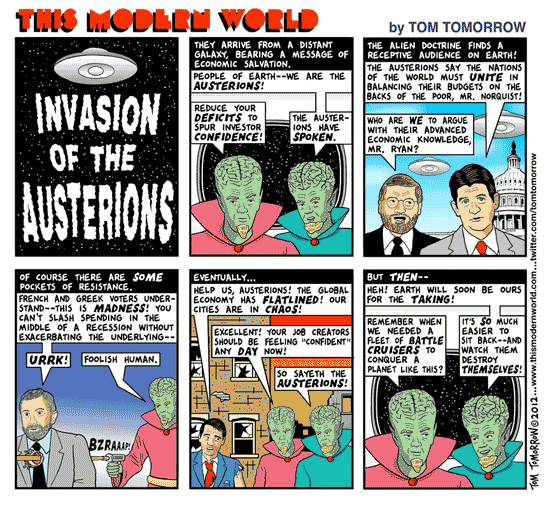
Thanks for visiting this blog, created in July 2012 out of great concern for the fate of the €uro currency area, once again on the verge of collapse due to the economically ill-advised and heartless austerity policies imposed on Greece, Spain and other heavily-indebted €uro area countries by a christian democratic German chancellor impressed with the budgeting skills of Schwabian housewives. Meant to reduce the public debt and put the countries back on a path to economic growth, these macro-economically idiotic policies are doing anything but cause "pointless misery" as Paul Krugman so aptly describes it (Bloomberg, July 23-29, 2012).

Instead of reducing public debt, the austerity measures set in motion a vicious cycle of economic contraction, rising unemployment and poverty, lower tax revenues, private capital flight, and rising public debt shares as the economy declines faster than the public debt. What’s more, the austerity-driven ‘blood, sweat and tears’ policies recommended to the European periphery derive from the same economic doctrine that brought us to the brink of disaster in 2008. These policies are not only misanthropic and counterproductive to economic growth and debt reduction in Europe, but will prove explosive for the €uro currency area unless a drastic change of course takes place - and soon.

While I do not pretend to have ‘the’ solution for the €uro crisis, I would like to offer alternative economic perspectives and views on current events, and hope to chart a more humane path toward a balanced, socially fair, and sustainable economic future for the €uro area.

On the origins of the 2008 Great Financial Crisis:
“
90+% of traders are men, and they bet all of our bank deposits on liar loans which froze credit leading to 40% average losses passed on to ordinary taxpayers; then begged for trillion-dollar bailouts upon which they paid themselves 50% higher boni.”


Sunday, March 24, 2013

Cyprus Cliffhanger


As announced in my last blog, I really wanted to write about a cockroach zombie roaming Germany and certain neighborhoods in Brussels. However, faced with an extraordinary Cyprus crisis cliffhanger, that will have to wait ‘til next time.

Due to the usual incompetence of EU officials combined with the incompetence and boneheadedness of leading German officials, we now have a situation in the eurozone which could lead to the collapse of the Cyprian banking system and the Cyprian economy if €5.8 bln in cash cannot be scraped together by Monday, March 25, the last day of ECB-liquidity help to the Cyprians. The euro crisis is back !

As no doubt you have all followed in the media, the catastrophy began to unfold when the gang of four (EU commissioner Olli Rehn, a representative of the IMF, ECB board memberAsmussen and German finance minister Schäuble) pretty much blackmailed the new president of Cyprus, Nikos Anastasiades, to finance a part of the EU bail-out with an obligatory tax of 9.9% on uninsured Cyprian bank deposits of €100.000 and above and a 6.75% tax on insured deposits below €100.000, effectively dismantling the EU deposit insurance guarantee. Otherwise, the ECB would stop its liquidity help to Cyprus' banks which would mean an immediate disorderly default. Mr. Anastasiades had no choice but to accept this poisonous deal.

While financial markets remained calm as the ECB reinsured investors that liquidity would be supplied to Cyprus' banks, the financial media, finance experts, and the Cyprian population went haywire when the news of the depositor bail-in became public. Some commentators called it “an unbelievably stupid decision”; a former ECB official from Cyprus even threatened that Cyprus would now sell gas exploitation licenses of  recently discovered natural gas fields to Russia instead of the EU. The best comment I read was only slightly more diplomatic, calling the deal “a huge blunder” and pointing out that, if the deal were to be approved by the Cyprian parliament, the EU would get the required €5.8 bln cash contribution to release €10 bln in EU-aid, yet it would still be too little, too late as depositors would withdraw all their deposits as soon as Cyprian banks reopened. The alternative (i.e. non-approval of the deal) would lead to the disorderly default of Cyprus' banks and possibly another massive bank crisis in other eurozone countries (see "Cyprus: the next blunder", March 18, 2013).

Today, 6 days later, we know that the Cyprian parliament rejected the deal and is desperately searching for another way to come up with the required €.5.8bln. The Russians have turned them down. The disorderly bank failures have not (yet) occurred as the ECB continues its liquidity provision until Monday, March 25. After that date, all bets are off. Interestingly, financial markets remained calm until the day the ECB made public the March 25 deadline. Since then, both equity and credit markets have reacted nervously. Depositors in other countries, however, apparently view the Cyprian situation as special and have not withdrawn their deposits. That is where we stand.

Now, it is easy to criticize the depositor bail-in deal without knowing all the facts, but difficult to come up with a better alternative in a strained situation. However, knowing our charm- and courtesy-challenged, boneheaded German machos, I am sure one could have easily handled the situation better and come up with a more democratic solution if one had treated the Cyprians with a little respect and negotiated with them as true partners, instead of assaulting them with a 'take-it or else'-type of proposition. My advice: next time in a critical situation, the EU should employ an all-women negotiating team !

The uproar in Cyprus has been gigantic, with swasticas and Merkel in nazi uniform displayed on many protest signs on the streets of Nicosia. With ongoing anti-austerity protests in Greece, Spain, Portugal and the 'vaffanculo' message from Italians, Germany now is easily the most hated country in the eurozone, its hard-won post-war reputation in shambles. Congratulation to the Merkel government ! We needed that like a hole in the head.

Olli Rehn, the EU commissioner already ridiculed and battered by Paul Krugman who labeled Rehn's policy decisions "cockroach ideas", has to serve as the scapegoat. Bloomberg reports that Rehn faced "a torrent of critiscm and a call to resign after helping broker a rescue package for Cyprus that fell apart." Nessa Childers, an Irish member of the EP, said in a telephone interview with Bloomberg: "Somebody somewhere has to be accountable and the buck stops with him"..."This was not only undemocratic, but incompetent. Was anyone thinking about the big picture?"

Right she is ! I think (and I'm not the only one), we need an entirely new, democratically elected leadership team for the eurozone. But first of all, the whole EU commission team responsible for the austerity policies plus the entire Merkel government should be fired. Let's do it at the ballot box this September !

Here is a good solution for the Cyprus crisis: take a page out of the book of Iceland.

Sunday, March 17, 2013

Did Euro-Austerians blink ?


No, not really: just a little PR and a lot of self-justification, but the austerity course remains intact.
Let me explain...

On March 10, I reported about the EU's initial reaction to the Italian election results and the mounting trans-atlantic critique of the draconian fiscal austerity imposed in the eurozone to pay for EU taxpayer-financed (bank) bail-outs. Just a day later, the German mainstream press wrote about a draft EU summit declaration that proposes a "differentiated growth-friendly fiscal consolidation strategy" and "short-term government programs for more growth and employment". Even Olli Rehn is said to have indicated that selected governments will get more time to reach their fiscal deficit targets. As a nod to Italy, the draft summit statement even provides space for productive public investment spending.

Bloomberg reports that "German officials have backed the commission's approach, indicating that the Berlin leadership is sensitive to criticisms that budget cutting has gone too far." (Bloomberg, March 15)  Is this a reaction to the warnings of the market gods (see video here) or a face-saving mea culpa of the "cocooned elite in Brussels", preparing the ground for a gradual dismantling of the fiscal austerity strategy ?

Hélas, I don't think so. I think, it's just part of a successful PR strategy pioneered by chancellor Merkel which is working like a charm in Germany: publicly, take a compromising step toward your opponents, slab a catchy name on the new strategy, introduce a few miniscule policy changes but leave the core strategy as is and publish a scholarly article to justify it (see "Fiscal policy in Europe: Searching for the right balance") 

Paul Krugman's comment on this "self-justifying piece on fiscal austerity":  "how does that 'delicate balance' [mentioned by the Commission] feel in countries with 15, 20, 25 percent unemployment ?"

                                 source:  Paul Krugman, "Of cockroaches and commissioners"

The EU commission's arguments to justify a continuation of austerity in the eurozone sadly demonstrate that the expansionary austerity zombie still roams our beautiful continent.

In my next post, I will report about a new PR campaign for a particularly indestructible zombie:
the cockroach zombie Agenda 2010, re-loaded.  

Sunday, March 10, 2013

The Euro-Austerian Empire strikes back


The reaction of EU austerians in response to the Italian election results was predictable: "Euro chiefs urge austerity", demanding (!) "that euro members press on with budget cuts to end the debt crisis" reports Bloomberg. Merkel is quoted: "Now in Europe, after the Italian election, it seems to be a case of either austerity and savings programs or growth, but that's a completely false premise" (she considers austerity measures combined with Agenda 2010-type labor market reforms as growth-enhancing). Of course, Merkel's minion Olli Rehn, EU economics commissioner, supports the view of the dominant economic power in Europe: "Given that average debt exceeds 90% of GDP in the EU, I don't think there's any room for manoeuvre to leave the path of budgetary consolidation" reports the UK Telegraph. It also comes as no surprise that Italy's president Giorgio Napolitano is exploring the creation of a second technocrat government with central bank governor Ignazio Visco to brake the political patt in Italy and calm markets in case Italy's parties are unable to form a stable government.

While Beppe Grillo dismissed these explorations as cattle market trading and vowed to "bring down the old system" in a civic revolution, the boneheaded austerity stance of EU commissioner Rehn provoked a hilarious trans-atlantic cockroach war between Paul Krugman (said to be one of Beppe Grillo's economic advisors) and three tweeters from Brussels. 


For economists, the battles between different economic ideologies may be fascinating and hilarious, especially when the tone of the debate slips into kindergarten-territory, but let's not forget that in the meantime people suffer. Many of the commentators from Europe are clearly in favor of Paul Krugman using "wild words" to draw attention to the desperate economic situation in Southern Europe and the incompetence of the "cocooned Brussels elite". Unfortunately, Paul Krugman's commentators are also correct in suggesting that all the empirical evidence and public uproar about the misery caused by austerity will not faze the EU power elite as a economic and humanitarian crisis may just be what they want: --> see my post on the role of crisis for the troika's economic shock therapy in Europe. "Only a crisis—actual or perceived—produces real change. When that crisis occurs, the actions that are taken depend on the ideas that are lying around. That, I believe, is our basic function: to develop alternatives to existing policies, to keep them alive and available until the politically impossible becomes politically inevitable." (Milton Friedman, “Capitalism and Freedom”) 

Meanwhile, however, the winds of change are picking up in Europe. Even mainstream German talkshows and newspapers have started to report about the true destinations of taxpayer-financed EU bailouts (namely French and German banks instead of the people in Greece, Ireland, or Portugal) and the lies being dished out by the Merkel government. Both the political left and the right in Germany have filed lawsuits in constitutional court to stop future taxpayer-financed bank bailouts while Europe-wide coordinated social movements are planning huge demonstrations in the spring. Seems all the trans-atlantic educational efforts of anti-austerians are beginning to have an effect.

Sunday, March 3, 2013

Message from Italy to Europe's Austerians: VAFFANCULO !!!


The big surprise in last Sunday's national election in Italy is the strong showing of former comedian Beppe Grillo’s “Five Star Movement” (with well-attended V-Day celebrations where V stands for Vaffanculo) which garnered 25% of valid votes, clearly ahead of Mario Monti's austerity-friendly centrist coalition which barely passed the 10% threshold. 


Italy's centre-left alliance led by Pier Luigi Bersani obtained a thin majority of votes (29.5%), but a secure majority of seats in the Chamber of Deputies thanks to a constitutional majority bonus of seats. Silvio Berlusconi’s centre-right alliance followed close behind with 29.2% of valid votes. In the Senate, no political group or party won an outright majority. (see “The Italian General Election of February 2013”)

Some say, the election results spell chaos for Italy and disaster for the EU and the euro project, others complain that Italians have chosen two clowns to run the country, referring to Berlusconi and Beppe Grillo. Well, that may be true, but just as the fools in Shakespeare’s plays, Italy’s so-called clowns are no fools at all. Just as their Shakespearean counterparts, Italian 'fools' are fearless in speaking the thruth and in uncovering deceit and misdeeds of people of higher standing. They do not follow any ideology and reject all appearances and traditional moral codes to make a valid point: that Italy's politicians are corrupt and that the austerity measures imposed by unelected EU technocrats are undemocratic, inhumane and unacceptable !

To me, the message to Italy's political caste and Europe’s austerians is loud and clear: We will not stand any longer for the fiscal austerity imposed by you on our people while you are filling your own pockets. If this is your vision for the European Union, then Vaffanculo - get yourself f.... !


Europe’s Very Serious People would do well NOT to deride or ridicule the democratic choices of Italians but should instead take heed and reassess their policies. Or would Europe prefer the rebirth of a new Mussolini? As Paul Krugman pointed out days before the Italian election results, “disreputable politicians are on the rise all across Southern Europe. And the reason this is happening is that respectable Europeans won’t admit that the policies they have imposed on debtors are a disastrous failure. If that doesn’t change, the Italian election will just be a foretaste of the dangerous radicalization to come.” (see “Austerity, Italian Style” NYT Feb 24, 2013)


I hope, the Independent European Daily Express is right in concluding, “Observers see the defeat of the reformer Monti and the surpisingly good results for EU critics Berlusconi and Grillo as a clear signal directed at Brussels that the austerity drive is coming to an end.” 

Sunday, February 24, 2013

Olli's follies and the Pros and Cons of TAFTA


The recent letter of EU commissioner Olli Rehn to EU finance ministers which, against overwhelming empirical evidence that austerity has failed (see graphs below), continues to support the economic equivalence of the Ptolemaic theory, just leaves me speechless in the face of so much arrogance and Besserwisserei (there is really no adequate english translation for this word, pedantery only comes close).

      Austerity and Changes in Debt-to-GDP ratios in the Eurozone 

Source: Paul de Grauwe; data source: Financial Times and datastream

    Austerity and Economic Growth in the Eurozone 

Source: Paul de Grauwe 

Since a number of other observers have already competently commented on this issue, please allow me to refer you to selected comments by Paul Krugman: "Euro Delusions", Karl Whelan, economics professor and former economist at the Federal Reserve: "Is Debate about Fiscal Multipliers unhelpful ?", Paul de Grauwe, professor of International Economics at the London School of Economics: "Panic-Driven Austerity in the Eurozone and its Implications", and an independent economic blogger in Brussels: "Die Kosten des Sparwahns."

I will instead comment upon another issue, proposed at the last EU summit: a trans-atlantic free trade agreement (TAFTA). This idea is not new. Already in 1995, European officials put forward a proposal for the creation of a US-EU free trade agreement, provoking me to write a paper about it while I spent a sabbatical at Harvard's Kennedy School of Government. The paper is rather wonkish, but might contain a few useful insights ---> see some extracts below:


EXTRACTS of a 1995 paper on the Pros and Cons of TAFTA
prepared for Harvard University, 
John F. Kennedy School of Government
(copyright held by the author of this blog)

Net Trade Gains from TAFTA

International trade theory is concerned with the efficiency of global resource allocation and the maximization of global welfare. The theory holds that global welfare rises if the formation of a free trade area (FTA) results in greater opportunities for specialization and trade. Conversely, global welfare suffers a decline if the FTA diverts trade from more to less efficient producers. Hence, according to traditional trade theory a free trade area improves global welfare if and only if its trade-creating effects outweigh its trade-diverting effects.1 In the next sections I will examine whether this might be the case with the creation of TAFTA.

Trade Creation2

According to Lawrence (1995) trade creation will be largest among FTA member countries with high initial levels of protection suppressing their trade.3 With the exception of agricultural trade, this is clearly not the case in the US or in Europe. Tariffs are already very low so that further tariff reductions under TAFTA are unlikely to result in large additional trade flows. However, TAFTA is likely to strengthen the competitive pressure on ‘outsiders’ to either join the group or create another free trade area (either complementary to or competing with TAFTA), thus spreading the process of liberalization and trade creation among other nations (domino effect).4

It is further argued that the mere increase in market size leads to economies of scale and scope and enhances the opportunities for specialization and trade. This effect is said to be strongest among countries that produce similar goods.5 On this point, the statistical evidence in favor of TAFTA is most convincing. With a common US-European market of 750 million people, a common GDP of $15 trillion,6 and an expected enlargement of the European Union to include Central and Eastern Europe in the not too distant future, the trade creation potential from TAFTA is enormous.

Recent experience also suggests that intra-industry trade and foreign direct investments (FDI) flourish particularly well among countries at similar stages of development. Borne out by statistical evidence of trade and investment flows among OECD countries during the past decade,7 TAFTA is likely to strengthen the already existing intra-industry trade and FDI-creating effects. Furthermore, the spill-overs from innovations induced by FDI will benefit TAFTA members as well as external producers, and is likely to create additional trade inside and outside of the free trade zone. 

Trade Diversion

One of the most salient arguments advanced in opposition of FTAs centers around the allocative efficiency implications of trade diversion from more to less efficient producers. This argument refers to the effects of discriminatory rules of origin or other barriers against producers outside of the FTA region. Even if trade creation is enhanced inside the FTA, trade diversion will occur, and global welfare will be impaired, if more efficient producers outside the free trade zone are prevented from competing with ‘inside’ producers. Bhagwati puts it bluntly: “[FTAs] are two-faced, bringing free trade to members, but amounting to implied protection against non-members.”8

This argument would indeed weigh heavily if TAFTA led to trade diversion as a result of discriminatory trade practices or other negative effects on outside producers9. Hence, to avoid any reduction in global welfare care should be taken to prevent and/or offset the potential trade-diversionary impact of TAFTA by lowering external tariffs as well as internal ones, by maintaining a non-discriminatory rules and regulations, and by keeping the group open for membership to all interested countries.10

A related view holds that even if the FTA is not discriminatory against outsiders it impedes efforts toward free global trade by diverting scarce resources away from multilateral trading initiatives and by providing an attractive alternative instead.11 The evidence from a recent WTO report suggests, however, that FTAs promote liberalization trends and thereby reinforce the global trading system. Rather than alternatives to free global trade, FTAs seem to be complements and stepping stones toward it.12

Yet, some economists warn that the global effects of TAFTA, especially when combined with APEC, may be extremely harmful to the multilateral trading system. TAFTA and APEC together cover 80% of world trade and encompass the most significant players and issues, leaving little room and scope for negotiation under the WTO umbrella.13 In view of the mounting international opposition to the formation of a ‘rich-country club’, it is advisable to avoid this exclusive image of TAFTA and keep it open to other regional and non-regional members, both rich and poor.14

Institutional Aspects of TAFTA15

While traditional trade theory focuses on the creation of trade flows and the minimization of trade diversion to optimize the global welfare impact of an FTA, non-traditional trade analysis takes a broader view of global welfare. It takes into account the effects of ‘deeper integration’ measures and addresses economic governance issues that affect the sovereignty of the nation state.16 In my view, a thorough assessment of the net gains from TAFTA also requires the weighing of the expected costs and benefits from the institutional changes under discussion.

Costs

If TAFTA remains limited to a cooperative trade and investment agreement with an à la carte menu of policy measures, the costs in terms of sovereignty loss will be minimal to zero. Since the US, however, envisions a number of ‘deeper integration’ measures such as the standardization of product tests and the harmonization of regulatory policies, there will be some adaptation costs to conform with common standards as well as some loss in independence in policy making. I expect that most of the costs from deregulation will be borne by European countries due to their much higher level of regulations and the extent of industrial policies applied in the region. 

Benefits

The potential trade- and investment benefits from institutional changes envisioned under TAFTA are sizeable. Regulatory harmonization and the mutual recognition of each other’s product standards and certification procedures will facilitate market access and reduce production and distribution costs. Further, the security of market access and the guarantee of FDI property rights will diminish investor uncertainty and is bound to stimulate two-way trade and investment flows as well as job creation on both sides of the Atlantic. Moreover, the benefits from institutional harmonization accrue to both internal and external producers.

Other Considerations

US public opinion on TAFTA seems to be divided. Its enthusiastic reception by multinational corporations comes as no surprise. Unexpectedly, however, TAFTA also enjoys strong support among labor unions and the democratic minority in Congress who view the agreement as their “last chance” to introduce Europe’s labor and welfare standards in the US.18 Given the maturity of the economies involved there is little concern about US workers’ pay being “undercut by the pitiful wages in poor countries.”19

Employer groups, on the other hand, are apprehensive about TAFTA’s expected upward pressure on US labor and welfare costs, and the potentially damaging effect on US competitiveness.20 Other groups argue that, as an exclusive rich-country club, TAFTA will be internationally divisive and result in the extension of Europe’s protective ‘tariff walls’ to the US.21

-------------------------------------------
1/Compare Lawrence (1995): “Regionalism, Multilateralism and Deeper Integration”, pp. 21-25.
2/Consistent with the new General Agreement on Trade in Services (GATS), foreign direct investments and other factor and non-factor service trade is included under the broad heading ‘trade’.
3/Ibid., p. 25.
4/Baldwin (1993: “A Domino Theory of Regionalism”) points out the “domino effect” of the proliferation of FTAs (cited in Lawrence,1995, p. 39).
5/Lawrence (1995), p. 26.
6/See the Economist of May 27, 1995: “In need of fastening”.
7/Recent trading patterns among OECD countries reflect growing intra-industry trade flows. Parallel to this trend, two-way FDI flows among OECD countries have tripled from 1982-92, growing several times faster than global trade and output (see Brooks-Senftleben, 1993: “Private Capital Flows .......: Overview of Recent Trends and Some Thoughts on Sustainability and Future Prospects”, Ibero-America Institute for Economic Research, Discussion Paper No. 62, p. 9).
8/Compare the arguments advanced by Bhagwati in the Financial Times of May 31, 1995: “Personal View - the High Cost of Free Trade Areas”.
9/Compare Lawrence (1995), pp. 26-27. He points out that outsiders may be hurt by a decline in their terms of trade due to lower demand for their imports from FTA members. However, Lawrence also argues that the negative terms of trade effect could be offset by income- and import-stimulating economies of scale effects inside the FTA.
10/A recent WTO report suggests that the trade-diverting impact of existing FTAs has been minimal to non-existent even though discriminatory rules of origin are widely applied (see the summary of key WTO findings in the Financial Times of July 12, 1995: “FT Exporter”).
11/Compare the comments by Mr. Ruggiero, head of the WTO, in the Financial Times of April 28, 1995: “Priorities in World Trade.”
12/Compare the Financial Times of July 12, 1995: “FT Exporter”.
13/The economists referred to are Anne Krueger and Jagdish Bhagwati (compare the Financial Times, of April 28, 1995: “Priorities in World Trade”.
14/Yi (1994) argues that FTAs that are open to outsiders will eventually lead to full multilateral free trade (see Yi, Sang-Seung: “Stable Structures of Trading Blocs and Welfare”, mimeo, Dartmouth College, cited in Lawrence, 1995, p. 42).
15/Compare Lawrence (1995) for an introduction to non-traditional trade analysis based on institutional effects.
16/For example subsidies or other industrial or trade policy measures (compare Lawrence, 1995, pp. 28-34.
17/TAFTA was first proposed by Mr. Kinkel, Foreign Minister of Germany. The European trade commission strongly favors the initiative (compare the Financial Times of April 20, 1995, and the Economist of May 27, 1995).
18/See the International Herald Tribune of June 8, 1995: “Europe’s Search for Security......”
19/Quoted from the Wall Street Journal of June 5, 1995: “US Backs More Liberal Trade Effort with Europe.....”
20/Compare the EIU Crossborder Monitor of June 21, 1995: “More Market Access: Trade Partners Wary of Bold Initiatives Globally.”
21/Ibid. and Financial Times, April 28, 1995: “Priorities in World Trade”.

Sunday, February 17, 2013

And what about Germany's 'synthetic' competitive devaluation strategy ?

This weekend’s Group of 20 meeting of finance ministers and central bankers in Moscow focused on the prevailing market fears of currency wars and a 1930’s style death spiral of competitive currency devaluations. Following the aggressive push for easier monetary policy by Japan’s new prime minister Shinzo Abe and the resulting slump in the Yen, the Group of Seven felt the need to sooth markets already before the G-20 meeting with the following statement:  

“We reaffirm that our fiscal and monetary policies have been and will remain oriented towards meeting our respective domestic objectives using domestic instruments, and that we will not target exchange rates.” 
(G-7 statement of February 12, 2013) 

Oh really ? While Jens Weidmann, president of Germany’s central bank, vehemently refutes the intention to devalue the euro (“the exchange rate of the euro is broadly in line with fundamentals” .....“you cannot really say that the euro is seriously overvalued”), at the same time he supports Merkel's synthetic competitive devaluation strategy in Europe, i.e. economic austerity policies that synthetically replicate a currency devaluation by changing the value of economic variables, with similar effects on the price of tradables (exports and imports) and export performance. 

Let me expain what I mean by 'synthetic' competitive devaluation:

Just as financial instruments can synthetically replicate risk exposures and generate similar returns as other financial instruments without the need for real assets [1], economic policies can be designed in such a way as to attain the same effect as a competitive currency devaluation without the need to change nominal currency values. For example, a combination of higher value added taxes (VAT) on consumer goods and a cut in payroll taxes or a payroll tax subsidy lowers unit labor costs and lowers export prices as export goods are exempt from VAT. This fiscal devaluation approach has recently been advocated by Harvard economist Gita Gopinath and colleagues as a response to the loss of competitiveness in the eurozone (see Gopinath et al., 2011: "Fiscal Devaluations") and is now being planned in France to revive the country's competitive edge. Keeping nominal exchange rates unchanged, the recommended combination of policies acts as an effective export subsidy and thus leads to the same outcomes as a nominal currency devaluation, namely an increase in exports. 

Germany's Merkel government has pioneered this synthetic currency devaluation approach already in 2007, combining an increase in VAT from 16% to 19% with a cut in employers' social security contributions from 6.5% to 4.2%. The fact that employees did not benefit from a similar cut in social security contributions clearly shows that it was meant to be a payroll tax subsidy for employers designed to lower unit labor costs, the standard measure of competitiveness [2], and thus increase exports. 

The fiscal devaluation in Germany was implemented in addition to the policy measures of Agenda 2010 which lowered nominal wages and non-wage labor costs and put pressure on general wage levels through various labor market liberalization and flexibilization measures. Using Germany's Agenda 2010 as a blueprint, the labor reforms imposed on Greece and other highly indebted countries in the Southern European periphery by Germany's Merkel government and the troika of IMF, EU commission and ECB encompass a number of measures designed (to lower unit labor costs [2] and increase competitiveness:
      • the lowering of nominal wages and social security contributions;
      • the reduction of unemployment payments;
      • the shortening of the eligibility period for unemployment payments;
      • the downward adjustment of public pensions;
      • the reduction or elimination of labor market regulations, facilitating 'hire and fire'.
The combination of Agenda 2010 and fiscal devaluation policies were so successful that Germany went from a trade deficit in the early 1990s (as a result of the economic boom following reunification with the former DDR) to the global export championship in nearly every year since 2000.

Germany's synthetic competitive devaluation approach, of course, also resulted in huge trade imbalances within the eurozone, injecting centrifugal forces so strong that they risk destroying the European monetary union. This risk is not yet banished but growing as long as Germany insists on generating trade surpluses within the eurozone.


Applying the same synthetic competitive devaluation policies in the entire eurozone will not solve matters, but simply transport the problem onto the global stage, increasing the risk of international protectionism and an implosion of international trade. 

I therefore welcome the final communique of the G-20 meeting in Moscow which reads in paragraph 5:

"We will refrain from competitive devaluation. We will not target our exchange rates for competitive purposes, will resist all forms of protectionism and keep our markets open."

Let's all hope that these words do not fall on deaf ears in Germany and the rest of Europe.

_____________________________________
    [1] For example, as the availability of mortgages to construct the highly lucrative mortgage-backed CDOs was limited, Wall Street quants simply designed synthetic CDOs using CDS to reflect the risk exposures of mortgages, thus creating an unlimitless universe of CDOs....the perfect weapon of financial mass destruction.   
    [2] Unit labor cost = average cost of labor per unit of output.

Sunday, February 10, 2013

CameroMerkel's austerity cum competitiveness-Agenda 2020 for the EU


"...Austerity measures are straining growth....We need growth, we need green growth, we need growth that is inclusive, that is job-creating, and that is gender-inclusive....
We need greater solidarity between and amongst generations."

Following Christine Lagarde's extraordinary speech in Davos.....as I was starting to dream of policymakers who, having learned from their mistakes, would immediately stop all austerity measures in the eurozone and implement policies supportive of inclusive growth, I was jerked back into the sad reality of Europe: while  enlightened people talk about inclusive growth and solidarity, our European nincompoop politicians keep playing the same old and tired tunes of austerity and competitiveness.

The EU budget deal of February 8 is an utter disaster, complete with the usual pork for the farmer’s lobby and other special interests, rebates for the oh-so-poor Brits and Danes, and a heavy dose of public service bashing by Britain’s Cameron (he demanded ! a €1 bln reduction in EU civil servants’salaries and pensions). The budget also includes the most non-sensical, pro-cyclical expenditure cuts on research, energy and transportation projects. Apart from €6 bln previewed for the fight against youth unemployment, there are NO funds allocated specifically to counter the disastrous economic and social effects of austerity measures in the Southern European periphery. Shameful ! What is the purpose of a European Union if not to help Europeans in a grave economic crisis ? 

Far from proposing to fund counter-cyclical economic recovery measures, the new European dream team of David Starve the Beast Cameron and Angela the Schwabian housewife Merkel forged an unholy alliance to push through the first ever real-term cut in the EU budget and a seven-year agreement on actual spending which is normally set year-by-year. The final agreement previews a 7-year budget of €960 billion [1] and actual spending allocations of €908 billion, down from the €994 billion spent in the current budget cycle. The difference between the budget plan and actual spending allocations results in a deficit of €52 billion already at the planning stage which clearly contradicts the intent of the recently enacted fiscal pact. (see  Bloomberg: “Europe Leaders Bow to Cameron Demand to Deepen Spending Cuts” and Lost in Europe: “Kein Zukunftsbudget”).

The European Parliament should put this budget deal where it belongs: into the garbage bin.

In addition to successfully pushing through an EU austerity budget, CameroMerkel discreetly directed EU president Van Rompuy to launch their competitiveness agenda, the so-called reform contract which would commit countries to competitiveness reforms along the lines of Germany's Agenda 2010. Central to this competitiveness agenda is the lowering of unit labor costs via nominal cuts in wages and non-wage benefits as well as labor market reforms that would facilitate the firing of workers and the individual determination of wages, thus putting additional downward pressure on wage levels.

European unions have already registered their protest in a press release by IndustriAll European Trade Union, an association of 197 national unions, arguing that the planned reforms are an attack against tariff autonomy and that the EU has no mandate for the determination of national wages. Resistance is also forming among Europe's social movements which are planning europe-wide action days for the EU summit in March.

_________________________
[1]  The proposed EU budget amounts to roughly 1% of EU-GDP and is dwarfed by public spending at the national level which averages 50% of GDP.