Thanks for visiting this blog, created in July 2012 out of great concern for the fate of the €uro currency area, once again on the verge of collapse due to the economically ill-advised and heartless austerity policies imposed on Greece, Spain and other heavily-indebted €uro area countries by a christian democratic German chancellor impressed with the budgeting skills of Schwabian housewives. Meant to reduce the public debt and put the countries back on a path to economic growth, these macro-economically idiotic policies are doing anything but cause "pointless misery" as Paul Krugman so aptly describes it (Bloomberg, July 23-29, 2012).

Instead of reducing public debt, the austerity measures set in motion a vicious cycle of economic contraction, rising unemployment and poverty, lower tax revenues, private capital flight, and rising public debt shares as the economy declines faster than the public debt. What’s more, the austerity-driven ‘blood, sweat and tears’ policies recommended to the European periphery derive from the same economic doctrine that brought us to the brink of disaster in 2008. These policies are not only misanthropic and counterproductive to economic growth and debt reduction in Europe, but will prove explosive for the €uro currency area unless a drastic change of course takes place - and soon.

While I do not pretend to have ‘the’ solution for the €uro crisis, I would like to offer alternative economic perspectives and views on current events, and hope to chart a more humane path toward a balanced, socially fair, and sustainable economic future for the €uro area.

On the origins of the 2008 Great Financial Crisis:
“
90+% of traders are men, and they bet all of our bank deposits on liar loans which froze credit leading to 40% average losses passed on to ordinary taxpayers; then begged for trillion-dollar bailouts upon which they paid themselves 50% higher boni.”


Sunday, August 25, 2013

Dear Fellow Eurozone Members: German Voters need your Help !

Germany’s current chancellor Angela Merkel used her power to influence important elections in your country. Why not return the favor ? By doing that, you could help your own austerity-damaged economies AND help German voters at the ballot box on September 22.  

Here is the problem: 
According to the latest polls (Emnid), Germany's voting populace is evenly split (45% vs. 45%) between the governing coalition of Merkel's CDU/CSU & FDP (liberal party) and the opposition combination of social democrats (SPD=25%), Greens (12%), and the left (Die Linke = 8%). Even when including the new party AfD (Alternative for Germany) on the conservative side and the pirates on the left (3 % each), we still have a stalemate. Furthermore, a large portion of the German voting population say that they might change their minds (72%) and the rest (roughly 30%) still does not know whom to vote for. 

Why not help German voters make up their minds ?
In fact, you should, as this national German election will largely determine future economic policymaking in the entire euro zone. As it stands now, the choices are not great: we will either remain stuck with Merkel, Schaeuble & the FDP, or a new Grand Coalition of Merkel & Steinbrueck, a combination that may improve economic policies only moderately, if at all. This is the base case scenario. The Merkel/Steinbrueck combination may even worsen economic policies as Steinbrueck, a staunch Agenda politician and a model cost- and deficit-cutter, may introduce Agenda 2020 with more cuts in wages and pensions in Germany and elsewhere in the eurozone, thus reinforcing the deflationary austerity and leading the eurozone into a depression. This, obviously, is the worst-case scenario. (see my posts "What do recent events mean for the EU and economic policymaking in the eurozone" and "A progressive alternative to Merkel's muddle-through government").

YOU, dear fellow eurozone member, could provide the jolt needed to lead Germany back to the right path, a path of true solidarity with its eurozone partners and economic policies that generate balanced, job-creating economic growth combined with a stable social safety net for the weakest members of society throughout the eurozone. 

How ?

Make yourself heard, by any means possible, and address social equity-loving Germans directly. Make sure they know that their tax money has not been used to help the citizens in Southern Europe but instead to bail out the banks and rich investors by transfering toxic and worthless assets from the private sector to the public sector, in other words: to YOU, the taxpayer. Make sure to let German voters know that this toxic asset transfer, combined with Merkel's austerity policies have INCREASED, not reduced, your country's debt load as the shrinking of your economies and, thus, the tax base also shrank tax revenues and economic growth. As a result, on top of a higher debt burden, your countries now have record unemployment and a lost generation of young people without any perspective to find a job.

Make sure German voters know about the economic and human misery chancellor Merkel's austerity policies has inflicted on your people, as the information about your people's suffering is largely withheld or smoothed over by Germany's mainstream press. Finally, make sure German voters realize that Merkel's social safety net-busting economic policies and their negative effects will NOT stop at Germany's borders but are planned to be extended throughout the eurozone with the help of the new Convergence and Competitiveness Instrument and the planned trans-atlantic trade and investment partnership TTIP.

May be, just may be, this will shake German voters so they'll finally wake up and smell the skunk Merkel's somniferous campaign wants to hide from them. The following videos from our Austrian euro partners may help as well (unfortunately only available in Austrian German, source: ORF):






Sunday, August 18, 2013

The sorry state of Germany's election campaign

Compared with past national election campaigns in Germany, the current one seems to be designed to lull people into sleep, a kind of surrealistic sleep that can easily turn into a nightmare: Merkel’s CDU plasters the countryside with “Friede, Freude, Eierkuchen” [peace, pleasure, and pancakes] posters depicting smiling German families cooking together or enjoying the beautiful German country side. 


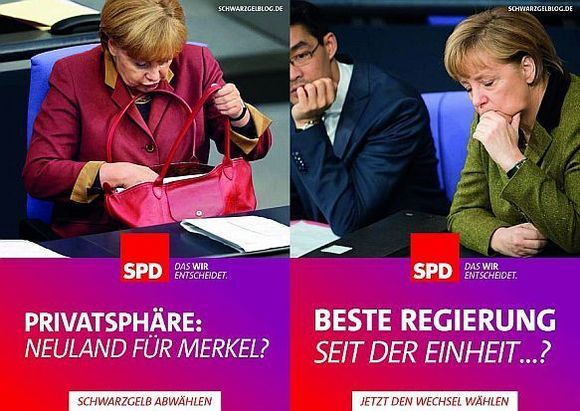
The main opposition party, SPD, runs a negative campaign against chancellor Merkel, yet shows her on every SPD-poster in a rather favourable light, repeating the statements she made about her government ("best government since unification"). The SPD’s own candidate remains invisible on the posters and nearly invisible on the campaign trail. While Merkel was on vacation, he tried to pick up his attacks against her disastrous economic management of the euro crisis – with little success as Germans do not (yet) feel the crisis.


Meanwhile, the Greens are making a fuss about the introduction of a “veggie day” to lower Germans’ meat consumption which harms animals and damages the environment. While this may be true, the German voter must be shaking her head, thinking “as if we don’t have other things to worry about”, fortifying the voter's perception of the Greens as quixotic Bionade elitists.

Even the left (Die Linke) is conspicuously tame, or so it seems as the party's messages are being completely ignored by the mainstream German press.

Yet, despite Merkel's continuing high popularity among the German people, her political standing could easily be challenged by spelling out the damage she has inflicted on the euro area (including Germany) since the start of the crisis, as I tried to do in my blog --->see the intro and many other posts describing the economic and human suffering Merkel's austerity policies have caused in Greece and other eurozone economies. The economic damage Merkel’s policies have caused will take years, if not decades, to repair.

Also: Merkel's perception as a good guardian of German taxpayers’ money is completely false. In fact, Merkel’s hesitant leadership at the very beginning of the crisis in Greece, combined with the economically idiotic austerity policies she and her finance minister Schäuble imposed on the Southern European periphery, unnecessarily cost German taxpayers a lot of money. And will do so in the future as Southern European economies continue to contract due to austerity, eroding tax bases and increasing (rather than lowering) public debt ratios, thus creating new financing gaps that need to be filled by European taxpayers. 

In addition to the economic damage, there is the political damage: within a short time span of 4 years, Merkel’s misanthropic handling of the euro crisis has eroded the trust and respect of our European neighbors that took Germany more than 60 years to painstakingly rebuilt after the horrors of the second world war. There is no telling yet whether Merkel’s policies have permanently damaged the European project, a project of peace, economic cooperation, and solidarity among European nations and peoples. But the arrogant, boneheaded demeanor of high-level German government officials and the heartless treatment of Germany's Southern European euro zone partners has no doubt negatively affected Germany's image in Europe and beyond. 

All these issues need to be addressed in a national election campaign, and openly discussed in public fora. Instead: silence ! Meanwhile the press contributes to the lulling in of the voter by disseminating the news that the eurozone’s economy has started to grow again, omitting to mention that, on an annual basis, the growth rate is still negative (see "Europe's False Recovery") .... and while 20 million Europeans (12.1%) remain stuck in unemployment, Merkel tells the voters that the euro crisis is nearly over.

Bloomberg's editors are right in saying that "Germans deserve a franker discussion of their situation than the comforting homilies about thrift she [Merkel] delivers on the campaign trail. They need to hear that exporting their savings to the rest of the euro area contributed to the crisis [and] that the bailouts are helping German banks as much as [more than] the recipient countries".... (see "Front-Runner Merkel Owes Both Germany and Europe the Truth" and my post of June 30, 2013, "Economic Rebalancing in Europe requires Germany to reduce Inequality at Home").


Sunday, August 11, 2013

Change we can believe in ?

Indeed, Obamaland is changing. Unfortunately, it's not always the change we were looking for.

The general mood in Obamaland seems good - at least in the Washington DC metro area, a relatively rich region whose economy has traditionally been less volatile than other regions thanks to its abundance of government jobs. Despite the automatic spending cuts from budget sequestration, the Washington metro area's $450 billion economy is doing well, the housing market has recovered, and home values are growing again. The Wall Street Journal even claims “Washington Enjoys Boom As Gilded Age Takes Root." George Mason economists expect the area’s annual GDP growth to accelerate to 3.2% by 2017, outpacing the rest of the country’s projected 2.9% annual growth rate.

The new growth engines of the region include many small to medium-sized enterprises started by former government employees or contractors in defense, intelligence and data management. “They’ve propelled the D.C.region as a leader in the cybersecurity and data sectors, as well as in educational products and health-care data management.” (Wall Street Journal, May/June 2013) Federal government spending may have provided the seed money for a strong, globally operating Washington economy, but “thanks to an economy that has steadily broadened beyond the government,”….”the region has shown surprising resilience” to the severe spending cuts. 

D.C. Living Wage Law
The solid economic performance of the DC metro area may explain the confidence of DC lawmakers to pick a fight with Wal-Mart, a globally operating retailer known for its rock-bottom wages with plans to open several stores in the District. On July 10, 2013, a day after Wal-Mart warned city legislators not to jeopardize its plans in the city, DC lawmakers gave final approval to a bill requiring large retailers to pay their employees a 50 % premium over the city’s minimum wage, currently at $8.25 an hour (see the Washington Post, “D.C. Council approves ‘living wage’ bill over Wal-Mart ultimatum”). Commenting on Wal-Mart’s threat to abandon its investment plans in the District, Vincent B. Orange (Democrat) said: “We’re at a point where we don’t need retailers. Retailers need us.” I wish, some of our German/European lawmakers had the same courage 


Under the Large Retailer Accountability Act, any new retail outlet affiliated with a parent company having yearly revenues of $1 billion or more would be subject to the wage requirement, regardless of the size of the store. The D.C. council committee's draft report stated: “The committee finds that large retailers can afford to pay its employees a living wage with decent benefits” (see the Washington Post of May 30, 2013. See also the comments in the German press: “Politikopfer des Tages: Walmart”).

Strike for higher wages at McDonald’s and Wendy’s
Also in July, thousands of fast-food workers mobilized to strike for higher wages in New York City, Chicago, St. Louis, Detroit, Milwaukee, Kansas City and Flint, Michigan, calling for a wage increase to $15 an hour (from the minimum wage of $7.25) and the right to join a union without retaliation. (See this article and this chart, depicting the demographics of the 21 million U.S. workers who earn between the minimum wage and $10 an hour). In contrast to the common perception that low-wage workers include only the unskilled and the young, a significant number of the low-wagers are college-educated people with children !

In Washington, hundreds of low-wage employees working for federal contractors walked out and picketed along Pennsylvania Avenue, demanding President Obama make good on his promise to “deliver on behalf of those people that are still struggling”….by raising the minimum wage, investing in green jobs and focusing on education and training" (speech at Knox college in Galesburg, Illinois in late July 2013).

Of course the Republicans, just as European conservatives, claim that wage increases destroy jobs and discourage employers from creating new ones - the old fairy tale. In fact, those arguments are just ‘catering to the rich’-politics as usual. Common economic sense, my own research and recent studies by H. Shierholz and others suggest the contrary: wage increases paid to low- and middle-income people CREATE JOBS as these income groups tend to spend the additional income, thus boosting aggregate demand and economic growth.

STASI in Obamaland ?
While the economy is improving, freedom, privacy, and US constitutional rights seem to be going down the tube. Rather than protecting whistleblowers as Obama promised to do, the Obama administration threatens to implement trade sanctions against any nation that will grant asylum to Edward Snowden and encourages government employees to snoop and spy on their own colleagues !!!

Shame on you, Mr. Obama ! Next thing we know, the Obama administration will build a wall to prevent US citizens from leaving the country... oh wait, it already exists to keep illegal Mexicans from entering the United States. Might as well prevent movements in the other direction as well, to keep American assholes out of Mexico and other useful purposes....


It’s high time for a woman president in the United States, a woman with the cojones, pardon: the courage to stand firm against the US military, security and bankster lobbies - a woman like Elisabeth Warren, outspoken advocate of consumer protection against Wall Street banksters, or Sheila Bair, author of "Bull by the Horns: Fighting to save Main Street from Wall Street and Wall Street from Itself."

Friday, July 12, 2013

Traveling in Obamaland.....

...back in Europe by early August. Yes, you calculated correctly: 4 weeks vacation ! Remaining vacation balance for 2013: 2 weeks. Eat your hearts out, Obamalanders !

Germans do take their vacation very seriously. Arbeit macht frei ? Mon derrière !


Will report about Orwellian Obamaland upon my return to Europe.

Sunday, June 30, 2013

Economic Rebalancing in Europe requires Germany to reduce Inequality at Home (UPDATE May 2014)

EU finance chiefs finally struck a bail-in deal for failing banks in the early morning of June 27. With this necessary (but not sufficient) step toward cleaning up Europe's banking sector out of the way, EU policymakers now need to tackle the fundamental causes of the euro crisis: the economic imbalances reflected in (still) widening current account imbalances in the eurozone (see "Euro Crisis Sees Reloading of Germany's Current Account Surplus").

Yes, it is true that the trade accounts of the countries in the Southern European periphery have improved. But that is largely due to lower import demand as a result of the collapse of the economies. Meanwhile, Europe’s export champion Germany continues to generate record export volumes and widening external surpluses, the last one at 7% of 2012 GDP or €240bln, globally the biggest in absolute terms. (see “Dissecting the miracle”) 


Just as powerful cars are mistakenly interpreted as a sign of the owner’s potency, Germans (mostly men) view their country’s superior export performance as a reflection of Germany’s economic potency. Yet, with each %age increase in Germany’s external surplus, the centrifugal forces tearing apart the common European currency zone are getting stronger. Hence, for those interested in preserving the euro and in maintaining the current euro membership intact, it is absolutely essential to reduce the economic imbalances in the euro zone. This requires:

(a) a correct analysis of developments that generated and still generate economic imbalances in Europe, and
(b) based on this analysis, a course of action for an economic rebalancing in the eurozone.

An excellent article by Michael Pettis, former JPMorgan trader/Managing Director and currently a professor of finance at Beijing University, does a pretty good job at both. The article has mysteriously disappeared from the internet, but his analysis can also be found in his book:


Pettis analysis starts with a real-world observation of the relationship between income concentration and national savings: As more and more wealth is concentrated in the hands of fewer people, consumption declines and national savings (defined as total production minus investment minus consumption) goes up, because the wealthier a person gets, the smaller the share of income he consumes. Hence, it is structural imbalances like income concentration and inequality in a country that determines national savings rates, not old-fashioned thrift. "In other words, national savings may have very little to do with household preferences and a lot to do with policy distortions."

When national savings are higher than the amount an open economy can or is willing to consume or invest profitably at home, the 'excess' savings are 'exported', e.g. as credits to foreigners to finance imports from the creditor country. The creditor country's current account then shows that its net export of savings (less net returns on investments) exactly equals its net export of goods and services: it has a current account surplus.  A current account deficit reflects the reverse: a shortfall of national savings compared with the country's consumption and investment needs, reflected in a shortfall of exports vs. imports. 

Germany is a case in point: following reunification in 1990 Germany ran current account deficits, importing capital to fund the reconstruction investments in the delapidated former DDR. To restore the usual current account surpluses, in 2003 Germany's powerful export lobby initiated and pushed through parliament a package of economic policy measures designed to improve competitiveness: Agenda 2010 restrained the growth of German wages and non-wage costs, causing the household income share of GDP and household consumption to drop and German savings rates to rise. As national savings soared, the German economy exported large and growing amounts of savings, financing the import of German consumption goods in the Southern European periphery and investing them badly in US mortgage-backed securities and sovereign bonds of eurozone countries (helped by financial regulations which treated sovereign bonds as 'risk-free' investments). As a result, while Germany's current account balance increased to 7.5% of GDP by 2007, offsetting current account deficits emerged elsewhere in the euro zone (15% of GDP in Greece, 10% in Portual and Spain, 5% in Ireland). 

(a) Summing up the analysis for Germany: as Agenda 2010 was implemented, the GDP-share of household income and household consumption declined. National savings rose because government consumption and investment also declined due to fiscal austerity and a lack of demand from the household sector. Income inequality skyrocketed as Germany's exporters garnered an ever larger share of income due to the booming exports to the Southern European periphery financed by Germany's excess savings. The result: large and growing economic imbalances in the eurozone, the danger of which is slowly being realized even in Germany (see "Der Fluch des guten Geldes", Manager Magazin, 18. Juni 2013).

b) A course of action for economic rebalancing in the euro zone would require reversing most, if not all, of the policies that led to this dangerously explosive situation. Michael Pettis correctly suggests that "the European crisis cannot be solved except by forcing down the German savings rate". Lowering the German savings rate can only be achieved by allowing German lower and middle-income households a much larger share of Germany's GDP. These income groups desperately need higher wages and a reinstalment of the social security benefits they had before Agenda 2010 (more generous pension and unemployment benefits a.o.). A cut in consumption taxes combined with a drastic increase in income taxes for higher income groups, a wealth tax, and a tax on financial transactions would complete the project.


By contrast, the Convergence and Competitiveness Instrument pushed by the Merkel government, i.e. Agenda 2010 re-loaded for the eurozone, would produce a contractionary shock not only for the eurozone but globally as the eurozone is the second largest economy in the world. It would:

- depress euro zone wages and generate euro zone current account surpluses 
- raise the value of the euro and increase the risk of deflation 
  (market data of May 2014 already confirm this expected development)
- persistent euro zone current account surpluses risk damaging trade relations with countries outside of the euro zone

Sunday, June 23, 2013

The planned Transatlantic Trade and Investment Partnership (TTIP) and Obama's visit in Berlin

Following the first ever real-term cut in the EU budget and the launch of the "Convergence and Competitiveness Instrument" pushed through by David 'Starve the Beast' Cameron and Angela 'the Schwabian Housewife' Merkel, CameroMerkel's austerity cum competitiveness-Agenda 2020 for Europe is proceeding to step 2: the Trans-Atlantic Trade and Investment Partnership (TTIP) of 800 million people, designed to overcome Europe's alleged "competitiveness crisis" --->see Cameron's EU speech of January 23, 2013. Here are some key extracts:

“There is a crisis of European competitiveness as other nations in the world soar ahead..…Europe’s share of world output is projected to fall by almost a third in the next two decades. This is the competitiveness challenge and much of our weakness in meeting it is, frankly, self-inflicted….[through] complex rules which restrict our labor markets"..…and “excessive regulation”.


"Europe is being outcompetet, out-investet, out-innovated and it is time we made the European Union an engine for growth, not a source of cost for business"...."You ought to deal with your debts, you ought to cut business taxes, you ought to tackle the bloat in welfare...."

This, of course, is music in chancellor Merkel's ears and explains why her initial plans of further institutional deepening of the EU (e.g. banking union, common fiscal policy etc.) are being delayed or have been completely put on ice. Instead, Merkel prefers the traditional British strategy of broader trade relations with as little government interference as possible. This also explains why TTIP fits perfectly into CameroMerkel's agenda. The potential benefits from institutional changes envisioned under TTIP are expected to be huge---> see extracts of my Harvard research paper on TAFTA in "Olli's follies and the Pros and Cons of TAFTA":

"Regulatory harmonization and the mutual recognition of each other’s product standards and certification procedures will facilitate market access and reduce production and distribution costs. Further, the security of market access and the guarantee of FDI property rights will diminish investor uncertainty and is bound to stimulate two-way trade and investment flows as well as job creation on both sides of the Atlantic." ....."TAFTA enjoys strong support among labor unions ..... who view the agreement as their “last chance” to introduce Europe’s labor and welfare standards in the US."...."Employer groups, on the other hand, are apprehensive about [an] expected upward pressure on US labor and welfare costs, and the potentially damaging effect on US competitiveness." [1]

The last sentence should give us pause: Knowing Cameron and Merkel and their close relations to  powerful corporate lobby groups, it can be expected that the traditional European labor and welfare standards our forefathers and -mothers fought and died for will be under heavy assault, including the standard sick leave protection continental Europeans enjoy, the 5-6 weeks annual vacation and the 5-day work week. A recent JP Morgan research paper on structural adjustment in the Euro area provides a flavor of things to come if US employers had their way (bold face markings by blog editor):

"....there are deep seated political problems in the periphery, which, in our view, need to change if EMU is going to function properly in the long run."......"Constitutions tend to show a strong socialist influence, reflecting the political strength that left wing parties gained after the defeat of fascism.....:  constitutional protection of labor rights; consensus building systems.....; and the right to protest if unwelcome changes are made to the political satus quo."......"Countries around the periphery have only been partially successful in producing fiscal and economic reform agendas, with governments constrained by constitutions...." (see JP Morgan's 16-page paper and comments here). 

Constrained by constitutional protection of labor rights and consensus building systems ? Not to worry: CameroMerkel's market-conform democracy will make amends. 

While Obama's words in Berlin (see extracts below) have soothed some of my concerns, they are just nice words and we have seen what happened to Obama's nice words about Guantanamo. Hence, it is important to be very very watchful and to supervise closely the upcoming TTIP negotiations (scheduled to begin already in July 2013 and expected to continue through 2014). Pan-European democratic supervision and input by all concerned social partners is absolutely essential ! 

For posterity, here are some extracts of Obama's Berlin 2013 speech directed squarely at Merkel's economic policy in the eurozone:

...."And now, as we emerge from recession, we must not avert our eyes from the insult of widening inequality or the pain of youth who are unemployed. We have to build new ladders of opportunity in our societies even as we pursue free trade and investment that fuels growth across the atlantic. America will stand with Europe as you strengthen your union. And we want to work with you to make sure that every person can enjoy the dignity that comes from work, whether they live in Chicago or Cleveland, in Belfast or Berlin, in Athens or Madrid - everybody deserves opportunity. We have to have economies that are working for all people, not just those at the top."


--------------------------------------------
[1] EIU Crossborder Monitor of June 21, 1995: “More Market Access: Trade Partners Wary of Bold Initiatives Globally.”

Sunday, June 16, 2013

The European Parliament: sole custodian of democracy and social justice in Europe ?

There are rays of light in the sorry state of economic and political affairs in Europe. The question is whether these rays of light are the glaring lights of a fast approaching train or the soft lights of a new morning dawning in Europe. Let's hope it's the latter.

On May 23, the European parliament passed a resolution demanding more democratic accountability on economic reforms in general and decisions regarding reforms and policy measures under the planned 'Instrument for Convergence and Competitiveness' in particular. After the successful vote, Green economic affairs spokesperson Sven Giegold correctly stated:

"Decisions about the economic future of Europe should not be taken by a handful of representatives from national governments and EU officials behind closed doors. There is a need to ensure much greater democratic accountability of any further moves towards economic union. The Commission and Council cannot continue to by-pass democracy through arcane pacts and intergovernmental agreements." [such as Merkel's new baby, 'Convergence and Competitiveness' pact - note by the blog host].

Sven Giegold continued:

“Any EU-level coordination of national reforms and economic policies must be subject to scrutiny and approval by democratically-elected parliaments and any legal framework with that purpose needs to be adopted under co-decision. Greater involvement of social partners in reforms will also bring more transparency and acceptance of these policies and the EP has today made these points. MEPs also called on the Commission to ensure sustainable development and social investments are not neglected and are rather at the core of its focus."  Amen !

Seven days later, Madame la Chancellière Merkel and President Hollande met and made a number of bi-lateral decisions without the annoying influence of other eurozone members and the European Parliament. These decisions, as published at length in a press notice of the German information office, include President Hollande's wish to promote economic growth and allow each country to decide on the speed of fiscal consolidation. It also includes, of course, Merkel's obsessions: the continuation of 'growth-friendly' fiscal consolidation and the 'boosting' of competitiveness, competitiveness, and competitiveness some more.

That blew the kettle in the European Parliament. On June 10, an alliance of all major EP party leaders and a broad majority of EP deputies motioned for a resolution to strengthen European democracy, strongly rejecting the back-door policies of national leaders: ..."reminds the European Council that it does not have any Treaty-based prerogative of legislative initiative and that it must stop instructing the Commission on the form and/or content of any further legislative initiative..."  "...Reiterates that it cannot accept any further intergovernmental elements in relation to the EMU and that it will take all necessary and appropriate action within its prerogatives if such warnings are not heeded;...." "....Recalls that EU participation in the 'troika' system should be subject to democratic scrutiny by, and accountability to, Parliament;..."

Need I say more?  It was high time the elected representatives of the European people put their feet down  to stop the undemocratic decision making of national leaders and unelected technocrats.