Thanks for visiting this blog, created in July 2012 out of great concern for the fate of the €uro currency area, once again on the verge of collapse due to the economically ill-advised and heartless austerity policies imposed on Greece, Spain and other heavily-indebted €uro area countries by a christian democratic German chancellor impressed with the budgeting skills of Schwabian housewives. Meant to reduce the public debt and put the countries back on a path to economic growth, these macro-economically idiotic policies are doing anything but cause "pointless misery" as Paul Krugman so aptly describes it (Bloomberg, July 23-29, 2012).

Instead of reducing public debt, the austerity measures set in motion a vicious cycle of economic contraction, rising unemployment and poverty, lower tax revenues, private capital flight, and rising public debt shares as the economy declines faster than the public debt. What’s more, the austerity-driven ‘blood, sweat and tears’ policies recommended to the European periphery derive from the same economic doctrine that brought us to the brink of disaster in 2008. These policies are not only misanthropic and counterproductive to economic growth and debt reduction in Europe, but will prove explosive for the €uro currency area unless a drastic change of course takes place - and soon.

While I do not pretend to have ‘the’ solution for the €uro crisis, I would like to offer alternative economic perspectives and views on current events, and hope to chart a more humane path toward a balanced, socially fair, and sustainable economic future for the €uro area.

On the origins of the 2008 Great Financial Crisis:
“
90+% of traders are men, and they bet all of our bank deposits on liar loans which froze credit leading to 40% average losses passed on to ordinary taxpayers; then begged for trillion-dollar bailouts upon which they paid themselves 50% higher boni.”


Wednesday, September 25, 2013

What do Germany's national election results mean for economic policies in the €uro zone ?

As predicted in my post of September 8, “Germany’s current chancellor Merkel will [most likely] also be the new one”. Voters gave Merkel and her Christian Democratic party CDU close to an absolute majority of votes (41.5%) while her current coalition partner, the market-fundamentalist liberal party FDP, was heavily punished for going against Merkel’s wishes on several important issues. They lost 10 percentage points and ended up with only 4.8% of the votes, just below the 5% minimum needed to enter the Bundestag.

Analyzing the election results by gender and age, my predictions of September 8 also came true: women over 50 largely voted for Ms. Merkel, while younger women preferred the Greens and men preferred Steinbrueck and his social democratic party SPD (see Spiegel Online: „Bundestagswahl 2013: So wählten die Deutschen“).

Results for the opposition parties
While Steinbrück’s social democratic party SPD was able to gain 2 percentage points compared with the results of the last national election in 2009, his party garnered only 26% of the votes this time. All other opposition parties lost votes: only 8.6% chose the Greens and the Linke, respectively. The Pirates didn’t even make it into the Bundestag, nor did the €uro-critical AfD (Alternative fuer Germany).

There are four special developments that may positively impact economic policy making in the €uro zone (the small ray of light at the end of tunnel):

First, chancellor Merkel lost her current coalition partner, the free marketeer FDP. As noted above, with only 4.8% of the votes they were unable to surpass the 5% hurdle and dropped out of the German Bundestag. The significance of this event for economic policy making in the €uro zone lies in the fact that the FDP has always been the party that insisted on strict conditionality for EU aid and prevented a moderation of the severe austerity course in Greece and other Southern European €uro members. Now that the FDP is gone, a less rigid adjustment process combined with the financing of desperately needed employment-creating investments and economic growth might be possible.

Second, the new, €uro-critical party AfD (alternative for Germany) did not make it into the German Bundestag. Had they entered, they might have stopped any financial help to €uro members and would have insisted on Germany’s exit out of the €uro zone and a return to the Deutsche Mark, with disastrous consequences for the €uro and the economies of the entire European continent, if not the planet.

Third, the economically very progressive Linke has become the third-largest party in the Bundestag, after the CDU/CSU and the SPD, and in front of the Greens! This development could very well be the most significant event for economic policy making in Germany and the €uro zone. Not only does the Linke promote higher German wages and pensions, as well as a reinstatement of former social security benefits and employee protections, thus supporting aggregate demand in Germany.and a reduction of economic imbalances in the €uro zone. The Linke also calls for an immediate stop of austerity policies in the €uro zone and the implementation of a massive investment program in Southern Europe to promote employment and growth. Furthermore, if I interpret their public statements correctly, the Linke calls for a write-off of sovereign debt related to the bail-out of banks and a clean-up of the entire European banking sector. Exactly the kind of policies that I and other progressive economists across the planet have been advocating.

Fourth, the opposition block of SPD (25,7% of the votes), the Linke (8.6%) and the Greens (8.4%) together garnered 42.7% of the votes, 1.2% more than chancellor Merkel’s conservative block’s 41.5%. Thus, the progressive block actually has the majority of seats in the German Bundestag and the power to form a government, including the nomination of a chancellor of their choice ! However, for reasons no rational person understands, the leaders of both SPD and Greens refuse to even speak with the Linke to explore the formation of a three-party coalition, the famous R2G (red-red-green) coalition, even though it is the only power option to replace the Merkel government and implement the desperately needed progressive, demand-side economic policies in Germany and the €uro zone. Conservative alpha males of the SPD and Greens even reject the formation of a two-party (SPD+Greens) coalition government ‘tolerated’ by the Linke ! As I noted in my post on “The Progressive Option for Germany and the Euro zone”, that kind of behavior is "undemocratic and childish. Time for a woman to tell those alpha males to go to their room and stay there until they are reasonable.”

Meanwhile, since the views of the alpha male leaders of the SPD and Greens do not necessarily represent the majority view of the parties’ membership base, reasonable women and men can discuss and design a workable coalition to replace the economically destructive Merkel government. And that’s where it gets interesting. As I noted in my post of September 15, “Analysis of Bavaria’s state election results“: "At that point the left [progressive] wings of the SPD and the Greens would push their party leaders to begin discussions with the Linke to form a progressive coalition instead of going into opposition of a third Merkel government.” 

Let’s hope that this will happen. This coming Friday, the SPD will hold a party convention with the task to decide on the future course of the party, i.e. either a grand coalition with Merkel, or a progressive R2G coalition or no coalition at all. The Greens are planning a party convention in mid-October. Let’s hope that the convention delegates of SPD and Greens will recognize that:

economic policymaking in the €uro zone is not a question of left or right, 
it’s a question of right or wrong !

As all three parties on the left agree that Merkel's economic course in the €uro zone is deadly wrong and urgently needs to be changed, perhaps the irrational fear of the big, bad Linke can be overcome.


Sunday, September 22, 2013

Still depressed in Germany, but there is a small ray of light at the end of the tunnel

Germany has voted for the safe option, with a call for more social equity.

My personal analysis of the vote will follow early next week as the evening is full of discussions and reviews. Plus, I have again killed my laptop and need to find another blogger tool.

Thanks for your patience.

Sunday, September 15, 2013

Analysis of Bavaria's state election results and its significance (or lack of) for Germany's national election

The state election results in Bavaria have little to NO significance for next week's national election in Germany as the conservative values and structure of Bavarian society is not representative of Germany as a whole. A leading German politician put it this way today: "the clocks are ticking differently in Bavaria", namely slower and more sedate since one cannot move very fast with a belly full of beer :-) [last part of the sentence = author's interpretation].

However, there is one clear pattern recently repeated in several German states: the liberal democratic party (FDP), champion of free enterprise and markets unconstrained by government regulation and interference, was unable to surmount the 5% minimum voting share and thus will not be represented in state parliament. If the same happens next week on the national level, it would mean that the current governing coalition of CDU/CSU and FDP could not continue and Merkel would have to look for another coalition partner. 

That's when it gets interesting: 
If the Greens have similar weak voting results as in Bavaria, we will get a new grand coalition of CDU (Merkel) and SPD (Steinbrueck) as the two parties together would have a stable, comfortable majority of 60% or more. If, on the other hand, the Greens were to attain strong results of 12% or more, it would still not be enough to form a stable coalition with the CDU, not to speak of substantial differences in their political programs. However, a Green showing of 12% or more PLUS 25% or more for the SPD plus 8% or more for the Linke together would be enough (45%) to truly threaten the formation of a new Merkel government. Because at that point the left wings of the SPD and the Greens would push their party leaders to beginn discussions with the Linke to form a progressive coalition instead of going into opposition of a third Merkel government. (see my post "The progressive option for Germany and the euro zone"). 

These discussions could divide the party members of the SPD and the Greens but, in my view, are necessary as one cannot simply ignore the democratic choice of nearly 10% of the German population that support the Linke and the power option they open up ---> see the discussion among leading German journalists and party members chez Anne Will:


I shall end my last post before next Sunday's national election by wishing each voter in Germany godspeed in making the right decision at the ballot box, for Germany AND for Europe as well. Let us remember that we, as descendants of a country that brought unimaginable horrors and suffering over the peoples of Europe, have a special responsibility to our European euro partners and neighbors. I pray that the good in us will prevail and NOT confirm the impression Thomas Mann had of Germans right after the end of world war II:

„Alle meine Eindrücke und viele direkte Nachrichten deuten darauf hin, das sich in Deutschland wenig oder nichts geändert hat, dass es das alte Nazi-Land ist, überheblich wie je, frech gegen die Sieger, ich erfüllt, einzigartig, ohne jedes Eingeständnis von Schuld, unverschämt und nicht bereit, sich ‚umerziehen’ zu lassen. Es wäre dort ein so schlechtes Wohnen wie um 1930, dessen bin ich gewiss.“ (Thomas Mann, „Essays VI 1945-1950).

My imperfect translation of Thomas Mann's words: 
All my impressions and many direct news reports indicate that nothing much has changed in Germany, that it has remained the old Nazi country, arrogant as ever, insolent vis-à-vis the victors, narcissist, one-of-a-kind, without any confession of guilt, impertinent and not prepared to be re-educated. It would be a miserable life there like around 1930, of that I am certain. 

Sunday, September 8, 2013

Depressed in Germany


Having watched last Sunday's debate and the debate in the German Bundestag the following week, I am convinced that Germany's current chancellor Merkel will also be the new one. Not because she has more convincing arguments than her challenger, but simply because she comes across as more trustworthy, modest, and less aggressive than her challenger, Peer Steinbrueck. 

While the ma(i)nstream press is convinced that Steinbrueck caught up to Ms. Merkel thanks to his strong performance during the debate, the gentlemen of the press neglect the preferences of the largest voter group that holds the key to this national German election:  women over 50 ! These are women born before 1963 who experienced or actively participated in the women's movement of the 1960s and 1970s. These women - many of them highly educated, professionally successful and financially independent - do NOT appreciate overly confident, arrogant, and borderline aggressive alpha males like Mr. Steinbrueck who openly threatened Ms. Merkel during both debates. Plus, as noted in my post of last Sunday, Steinbrueck is acting childish and undemocratic by refusing a coalition with the LINKE, a democratic party supported by roughly 10% of the voters.

For all these reasons, women over 50 will most likely not vote for Mr. Steinbrueck's party, and that, Mr. Steinbrueck, is a huge loss as women over 50 make up 28.1% of the German voting population (see the data on the German voting population compiled by the Bundeswahlleiter here). These women will either vote for chancellor Merkel or for the LINKE, not for the SPD, nor the Greens due to their most recent pedophile scandals. My prognosis is all the more likely as the largest voter group has been completely ignored by Mr. Steinbrueck's party and the Greens: driving through a major city in central Germany one can observe that SPD campaign posters display almost exclusively middle-aged white men while the Greens focus on young women and children. Only the campaign posters of Ms. Merkel's party, the CDU, depict smartly dressed middle-aged and older women. Well, if the largest group of women voters in Germany is being ignored by the SPD and the Greens, why should these women vote for them ? 

So, we probably end up as I predicted last September:

"....knowing the Angst-ridden Germans, they will probably support a party combination that seems safe: either Merkel's CDU + the conservative wing of the social democrats, or Merkel's CDU + the conservative wing of the Greens. Both combinations would mean a continuation of the current austerity policies for Europe, albeit with a stronger focus on investments and growth."


Now you know why I'm depressed.

Sunday, September 1, 2013

The Progressive Option for Germany and the Euro Zone: a G2R coalition led by the Greens

Three weeks before Germany’s (and Europe’s) most important election since 2009, the polls continue to predict a near-stalemate (Patt) between the two opposing camps. The governing conservative coalition of CDU/CSU & FDP is estimated to garner 45%, the opposition of SPD (red=R), Greens (=G), and the LINKE (red=R) together would atttain 44%, of which the SPD with chancellor candidate Steinbrueck would contribute only 23%. These results come as no surprise to me given my earlier assessment of Peer Steinbrück (see my post "What do recent events mean for the EU and economic policy in the eurozone?").

As a former finance minister responsible for the deregulation of Germany’s financial sector, and a millionaire from speaking fees he made while on the payroll of the German taxpayer, he not only lacks credibility as a candidate for the average voter. He also comes across as arrogant, old-fashioned and macho, an attitude that does not sit well with the largest group of voters: namely women over 50, many of whom share the experience of being passed over for leadership positions by a less qualified and less experienced German alpha male.

Yet, what hurts Steinbrueck the most is his continued support of former chancellor Schroeder’s Agenda 2010 policies which punched huge holes into Germany's social safety net, created a new bottom-feeding low-wage sector (down to €1 an hour) and precarious employment conditions for many workers, esp. the young, the low-skilled, and those with an immigrant background. This in a country whose 19th century chancellor Otto von Bismarck pioneered the introduction of a social security system for workers and which derived much of its post-war stability and economic success from its tightly knit social safety net and good treatment of its highly productive German employees ! Not surprisingly, following the introduction of Agenda 2010 policies in 2003, Schroeder's coalition with the Greens was quickly voted out of power in 2005, allowing Merkel to take over. That lesson should have been learned by now – but NO, not by Steinbrueck & Co. He even decided that former chancellor Schroeder – the nemesis for many Agenda-hating Germans – should help him in his campaign. Result: SPD polling numbers declined by 1-2%age points.

The understandable reaction of voters who don’t wish a repeat of the SPD/Greens coalition of 2003 but don’t want a continuation of the Merkel government either: choose the LINKE instead, the only party that plans a reinstatement of the German safety net, the dismantling of the low-wage sector, and the reinstatement of former employee protections on Germany’s labor market. According to the latest polls, roughly 10% of the voters would choose the LINKE, sending a loud message to the SPD and the Greens: we don’t want a repeat of the SPD/Greens coalition that implemented the Agenda policies, therefore we are voting for a strong LINKE to enable a red-red-green coalition (R2G = SPD+Linke+Greens). Public reaction of the SPD (and some Greens): we will not form a coalition with the LINKE, period. The problem is: an SPD/Greens coalition alone will most likely NOT get a majority which means that SPD and Greens would (again) have to yield power to another Merkel government.

Helloooo !!!!! Anybody home ?????  Do you (conservative members of the SPD and Greens) really want to ignore 10% of the voting population because your alpha males don't want to 'play' with the LINKE ? That’s undemocratic and hopelessly childish. Time for a woman to tell those alpha males to go to their room and stay there until they are reasonable. While the alpha males sulk in their rooms, reasonable women and men are free to think of other ways out of this dilemma. The only other option for voters who neither want a continuation of the Merkel government nor a repetition of the 2003 SPD/Greens coalition is a progressive G2R coalition (Greens+SPD+LINKE) led by Juergen Trittin of the Greens. In contrast to Peer Steinbrueck, Trittin has no Agenda skeletons in his closet and, to my knowledge, has never ruled out a coalition with the LINKE, which holds the key to the only true power option to send the Merkel government packing and reshape economic policy in Germany and the eurozone.

In contrast to a Steinbrueck government, a Trittin government would be an economically progressive, left-of-center government. I agree with Wolfgang Münchau, an economic journalist for the Financial Times: the Greens and the Linke are the only two parties that provide an honest and correct analysis of the euro crisis. In contrast to Münchau, however, I think that a G2R coalition (rather than an R2G coaliton) would be able to design the best economic policies for a socially fair and progressive solution of the euro crisis and a better life for those left behind in Germany.   

Sunday, August 25, 2013

Dear Fellow Eurozone Members: German Voters need your Help !

Germany’s current chancellor Angela Merkel used her power to influence important elections in your country. Why not return the favor ? By doing that, you could help your own austerity-damaged economies AND help German voters at the ballot box on September 22.  

Here is the problem: 
According to the latest polls (Emnid), Germany's voting populace is evenly split (45% vs. 45%) between the governing coalition of Merkel's CDU/CSU & FDP (liberal party) and the opposition combination of social democrats (SPD=25%), Greens (12%), and the left (Die Linke = 8%). Even when including the new party AfD (Alternative for Germany) on the conservative side and the pirates on the left (3 % each), we still have a stalemate. Furthermore, a large portion of the German voting population say that they might change their minds (72%) and the rest (roughly 30%) still does not know whom to vote for. 

Why not help German voters make up their minds ?
In fact, you should, as this national German election will largely determine future economic policymaking in the entire euro zone. As it stands now, the choices are not great: we will either remain stuck with Merkel, Schaeuble & the FDP, or a new Grand Coalition of Merkel & Steinbrueck, a combination that may improve economic policies only moderately, if at all. This is the base case scenario. The Merkel/Steinbrueck combination may even worsen economic policies as Steinbrueck, a staunch Agenda politician and a model cost- and deficit-cutter, may introduce Agenda 2020 with more cuts in wages and pensions in Germany and elsewhere in the eurozone, thus reinforcing the deflationary austerity and leading the eurozone into a depression. This, obviously, is the worst-case scenario. (see my posts "What do recent events mean for the EU and economic policymaking in the eurozone" and "A progressive alternative to Merkel's muddle-through government").

YOU, dear fellow eurozone member, could provide the jolt needed to lead Germany back to the right path, a path of true solidarity with its eurozone partners and economic policies that generate balanced, job-creating economic growth combined with a stable social safety net for the weakest members of society throughout the eurozone. 

How ?

Make yourself heard, by any means possible, and address social equity-loving Germans directly. Make sure they know that their tax money has not been used to help the citizens in Southern Europe but instead to bail out the banks and rich investors by transfering toxic and worthless assets from the private sector to the public sector, in other words: to YOU, the taxpayer. Make sure to let German voters know that this toxic asset transfer, combined with Merkel's austerity policies have INCREASED, not reduced, your country's debt load as the shrinking of your economies and, thus, the tax base also shrank tax revenues and economic growth. As a result, on top of a higher debt burden, your countries now have record unemployment and a lost generation of young people without any perspective to find a job.

Make sure German voters know about the economic and human misery chancellor Merkel's austerity policies has inflicted on your people, as the information about your people's suffering is largely withheld or smoothed over by Germany's mainstream press. Finally, make sure German voters realize that Merkel's social safety net-busting economic policies and their negative effects will NOT stop at Germany's borders but are planned to be extended throughout the eurozone with the help of the new Convergence and Competitiveness Instrument and the planned trans-atlantic trade and investment partnership TTIP.

May be, just may be, this will shake German voters so they'll finally wake up and smell the skunk Merkel's somniferous campaign wants to hide from them. The following videos from our Austrian euro partners may help as well (unfortunately only available in Austrian German, source: ORF):


Sunday, August 18, 2013

The sorry state of Germany's election campaign

Compared with past national election campaigns in Germany, the current one seems to be designed to lull people into sleep, a kind of surrealistic sleep that can easily turn into a nightmare: Merkel’s CDU plasters the countryside with “Friede, Freude, Eierkuchen” [peace, pleasure, and pancakes] posters depicting smiling German families cooking together or enjoying the beautiful German country side. 


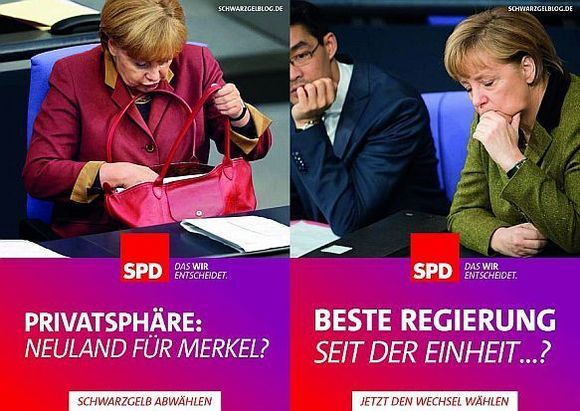
The main opposition party, SPD, runs a negative campaign against chancellor Merkel, yet shows her on every SPD-poster in a rather favourable light, repeating the statements she made about her government ("best government since unification"). The SPD’s own candidate remains invisible on the posters and nearly invisible on the campaign trail. While Merkel was on vacation, he tried to pick up his attacks against her disastrous economic management of the euro crisis – with little success as Germans do not (yet) feel the crisis.


Meanwhile, the Greens are making a fuss about the introduction of a “veggie day” to lower Germans’ meat consumption which harms animals and damages the environment. While this may be true, the German voter must be shaking her head, thinking “as if we don’t have other things to worry about”, fortifying the voter's perception of the Greens as quixotic Bionade elitists.

Even the left (Die Linke) is conspicuously tame, or so it seems as the party's messages are being completely ignored by the mainstream German press.

Yet, despite Merkel's continuing high popularity among the German people, her political standing could easily be challenged by spelling out the damage she has inflicted on the euro area (including Germany) since the start of the crisis, as I tried to do in my blog --->see the intro and many other posts describing the economic and human suffering Merkel's austerity policies have caused in Greece and other eurozone economies. The economic damage Merkel’s policies have caused will take years, if not decades, to repair.

Also: Merkel's perception as a good guardian of German taxpayers’ money is completely false. In fact, Merkel’s hesitant leadership at the very beginning of the crisis in Greece, combined with the economically idiotic austerity policies she and her finance minister Schäuble imposed on the Southern European periphery, unnecessarily cost German taxpayers a lot of money. And will do so in the future as Southern European economies continue to contract due to austerity, eroding tax bases and increasing (rather than lowering) public debt ratios, thus creating new financing gaps that need to be filled by European taxpayers. 

In addition to the economic damage, there is the political damage: within a short time span of 4 years, Merkel’s misanthropic handling of the euro crisis has eroded the trust and respect of our European neighbors that took Germany more than 60 years to painstakingly rebuilt after the horrors of the second world war. There is no telling yet whether Merkel’s policies have permanently damaged the European project, a project of peace, economic cooperation, and solidarity among European nations and peoples. But the arrogant, boneheaded demeanor of high-level German government officials and the heartless treatment of Germany's Southern European euro zone partners has no doubt negatively affected Germany's image in Europe and beyond. 

All these issues need to be addressed in a national election campaign, and openly discussed in public fora. Instead: silence ! Meanwhile the press contributes to the lulling in of the voter by disseminating the news that the eurozone’s economy has started to grow again, omitting to mention that, on an annual basis, the growth rate is still negative (see "Europe's False Recovery") .... and while 20 million Europeans (12.1%) remain stuck in unemployment, Merkel tells the voters that the euro crisis is nearly over.

Bloomberg's editors are right in saying that "Germans deserve a franker discussion of their situation than the comforting homilies about thrift she [Merkel] delivers on the campaign trail. They need to hear that exporting their savings to the rest of the euro area contributed to the crisis [and] that the bailouts are helping German banks as much as [more than] the recipient countries".... (see "Front-Runner Merkel Owes Both Germany and Europe the Truth" and my post of June 30, 2013, "Economic Rebalancing in Europe requires Germany to reduce Inequality at Home").